Picture a road at night where three paths meet. No streetlight, no signpost you can read in the dark. You have to choose, and you can't see far enough down any of them to know where they lead.
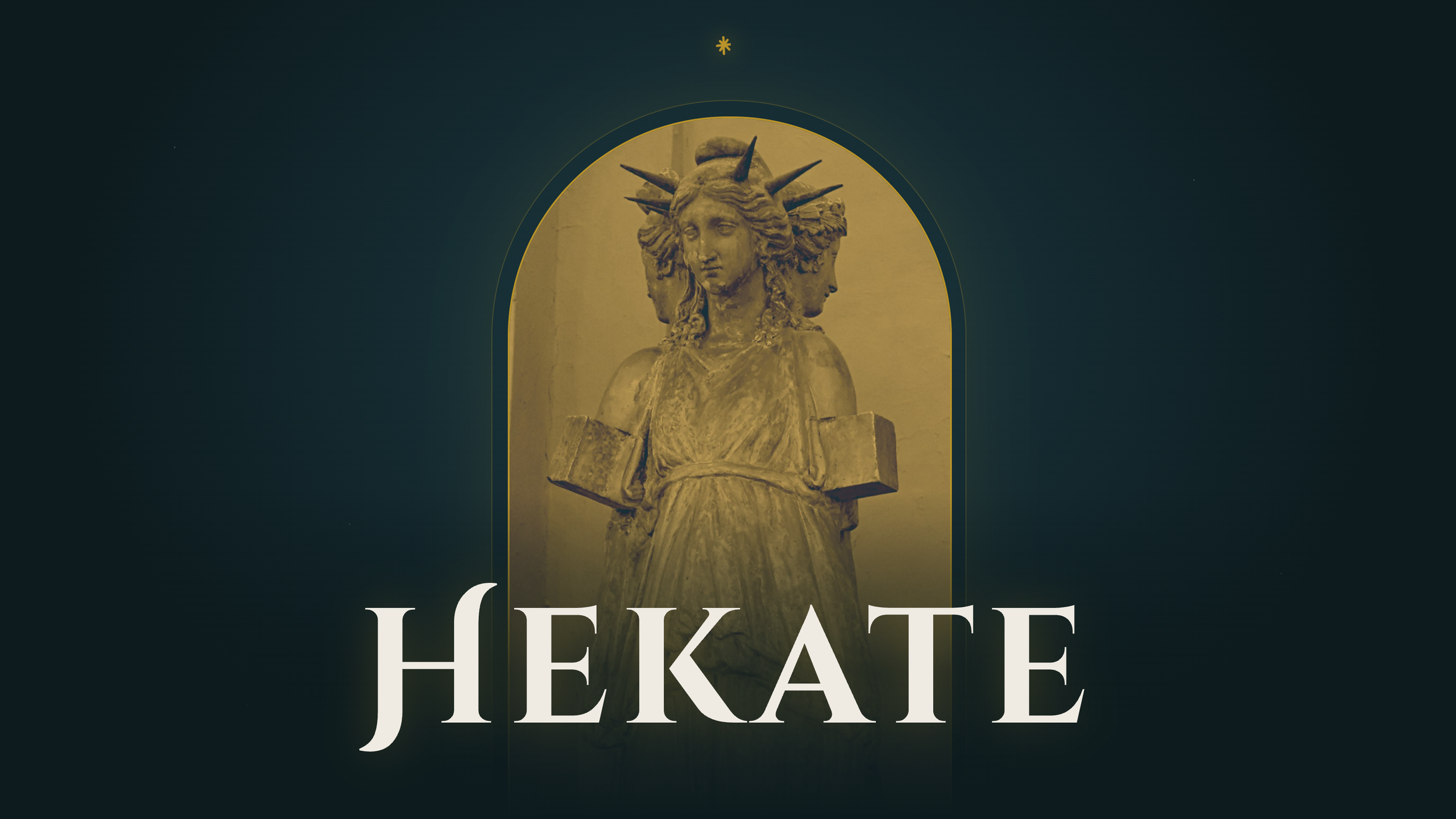
The ancient Greeks knew exactly who stood at that spot. They set her statue there, three faces looking down three roads, a torch in her hands. Her name was Hekate.
Today she's often reduced to a "witch goddess" on a moody Pinterest board. She is that, in part. But the real Hekate, the one who shows up in the oldest Greek poems, is far bigger and far stranger. She held power in the earth, the sea and the starry sky. She was the only goddess who heard Persephone scream. She was the keeper of keys, the lighter of dark paths, and in late antiquity, the soul of the whole cosmos.
Here is who Hekate was, in the words of the people who actually prayed to her, and why she belongs to the crossroads.
In this post:
Where Hekate Came From
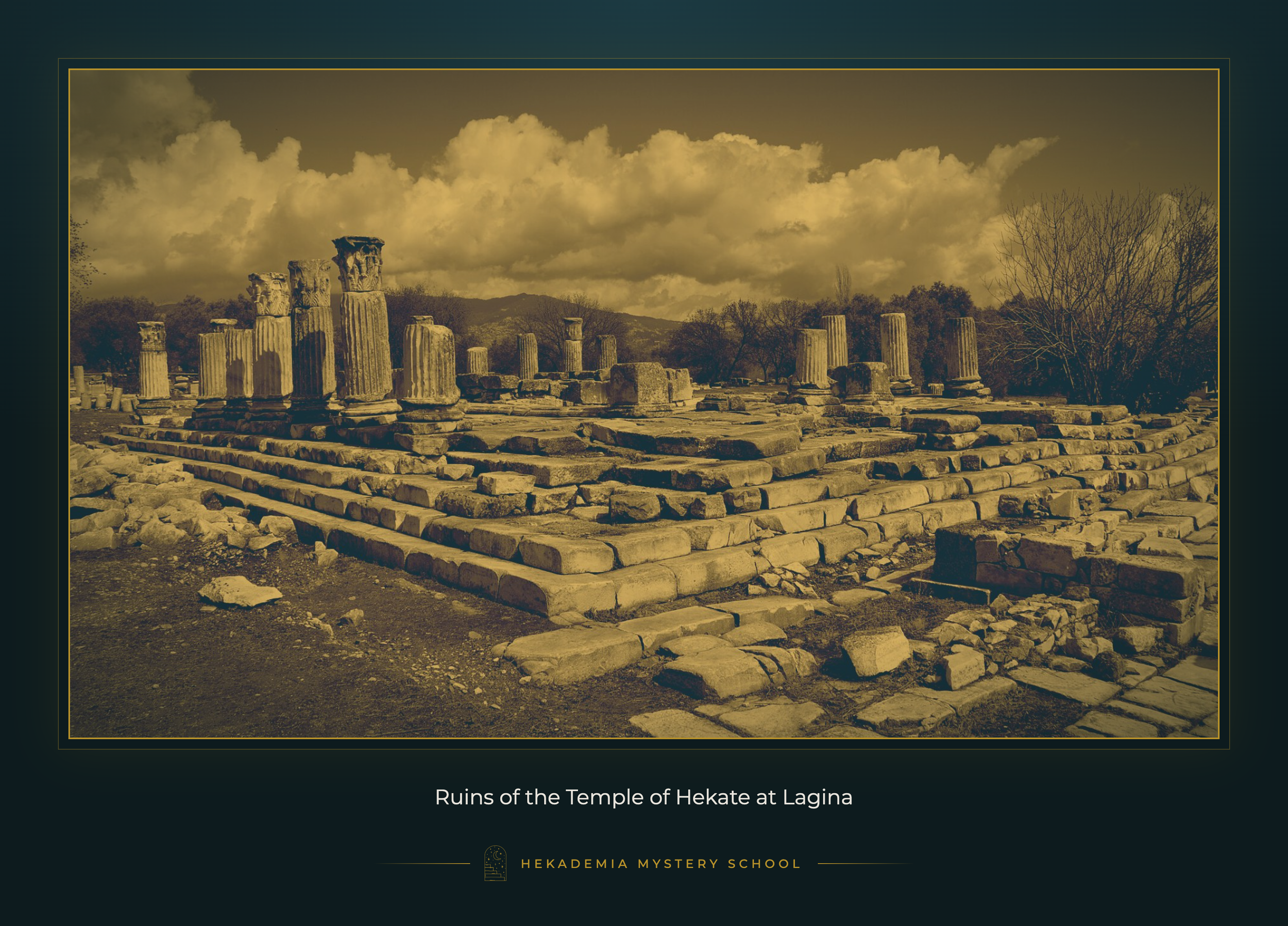
Hekate probably wasn't Greek to begin with. Most scholars trace her roots to Caria, in what is now southwestern Turkey. Homer never mentions her. Her greatest temple stood not in Athens but at Lagina, in Caria, where worship at the site goes back at least to the fourth century BCE.
At Lagina she was the protector of the nearby city of Stratonikeia. Her biggest festival centered on a procession of the key. Young girls, the kleidophoroi or key-bearers, carried Hekate's sacred key along a 10 km sacred road between her sanctuary and the city. Hold onto that image of the key. We'll come back to it.
Her first appearance in Greek writing is surprising if you only know her as a spooky night goddess. Around 700 BCE, the poet Hesiod stops his Theogony, the great genealogy of the gods, to sing her praises at length. He names her parents as the Titans Perses and Asteria (whose name means "starry one"), and then says something he says of no other goddess:
"She conceived and bore Hecate whom Zeus the son of Cronos honored above all. He gave her splendid gifts, to have a share of the earth and the unfruitful sea. She received honor also in starry heaven."
Hesiod, Theogony 411 to 415 (trans. H. G. Evelyn-White, 1914)
Earth, sea and sky. When Zeus overthrew the Titans, he stripped most of the old gods of their power. Hekate he left alone. Hesiod says she kept her privileges "both in earth, and in heaven, and in sea," exactly as they were from the beginning.
Hesiod's Hekate is generous. She sits beside kings in judgment. She gives victory in battle and at the games. She fills fishermen's nets and grows herds of cattle and sheep, and can just as easily shrink them. And Zeus made her a nurse of the young, a guardian of every child born into the light.
This is a goddess of tremendous range. She isn't confined to one realm, like Poseidon to the sea or Hades to the underworld. She moves between all of them. That's the first clue to everything she later becomes.
The Torchbearer: Hekate and Persephone
“She is the one who hears you from the dark, before anyone else notices you’re gone.”
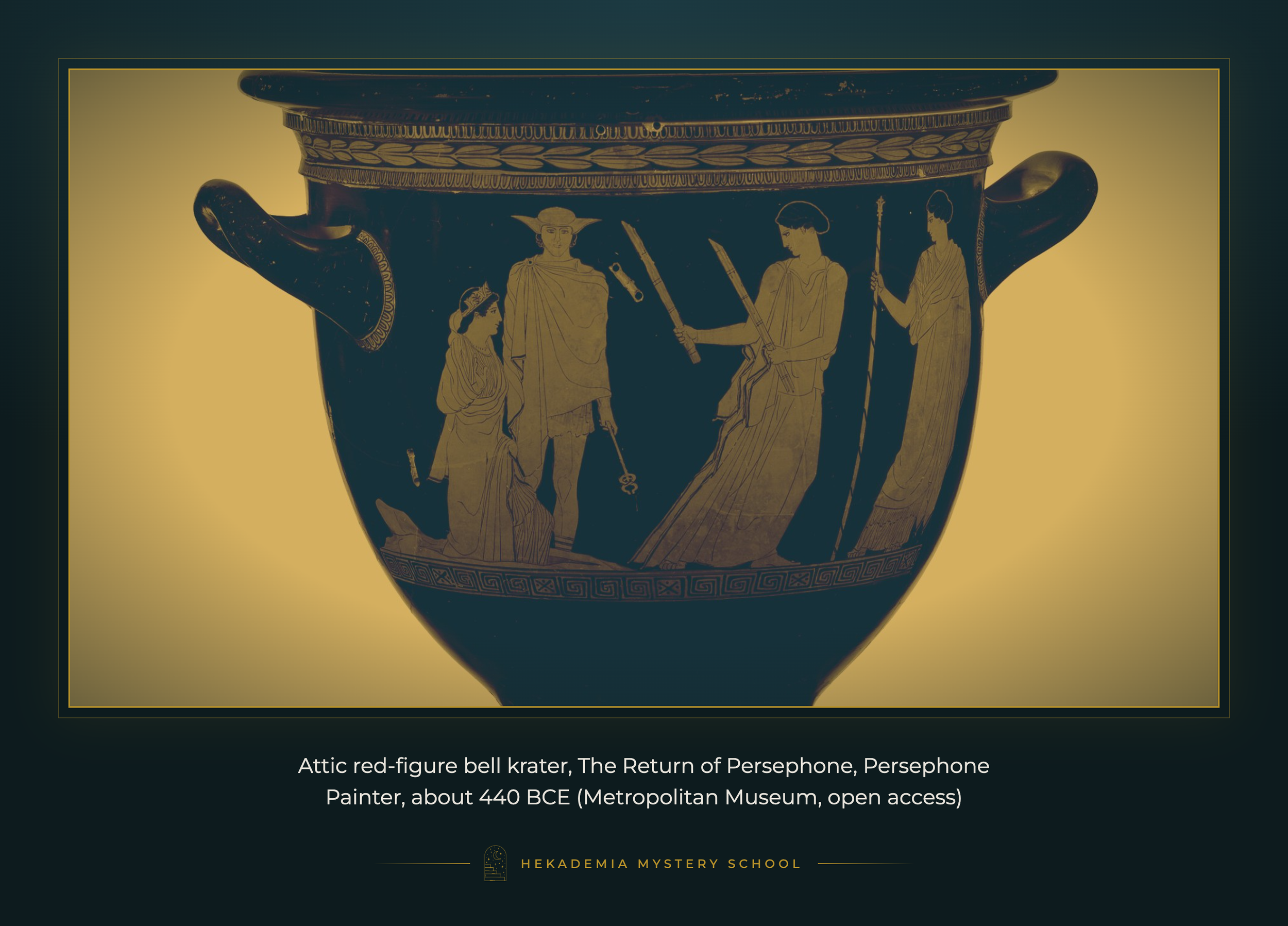
If you read our post on the Eleusinian Mysteries, you already know the story at the heart of those rites. Hades seizes Persephone and drags her underground. Her mother Demeter searches the earth in grief. The Homeric Hymn to Demeter, the sacred story of Eleusis, written down around the seventh century BCE, tells us something easy to miss. When Persephone cried out, almost no one heard her:
"Only tender-hearted Hecate, bright-coiffed, the daughter of Persaeus, heard the girl from her cave."
Homeric Hymn to Demeter 24 to 25 (trans. Evelyn-White)
Only Hekate, and the Sun. For nine days Demeter wanders with flaming torches, refusing food and drink. Then, on the tenth dawn, Hekate comes to meet her, "with a torch in her hands," and tells her what she heard. Together the two goddesses go to Helios, the Sun, who saw everything, and learn the truth.
Then comes the line that matters most. When Persephone finally returns to the upper world and the mother and daughter are reunited, Hekate comes to them, embraces Persephone many times, and:
"From that time the lady Hecate was minister and companion to Persephone."
Homeric Hymn to Demeter 440 (trans. Evelyn-White)
Think about what that means. Persephone now lives half her year in the land of the dead and half in the land of the living. Hekate becomes the one who walks with her, lighting the way down and the way back up. She is the companion of every descent and every return.
This is why Hekate is so often shown holding two torches. And it's why, for anyone doing deep inner work, she is such a meaningful figure. She is the one who hears you from the dark, before anyone else notices you're gone, and she carries a light into places no one else will go.
Why the Crossroads?
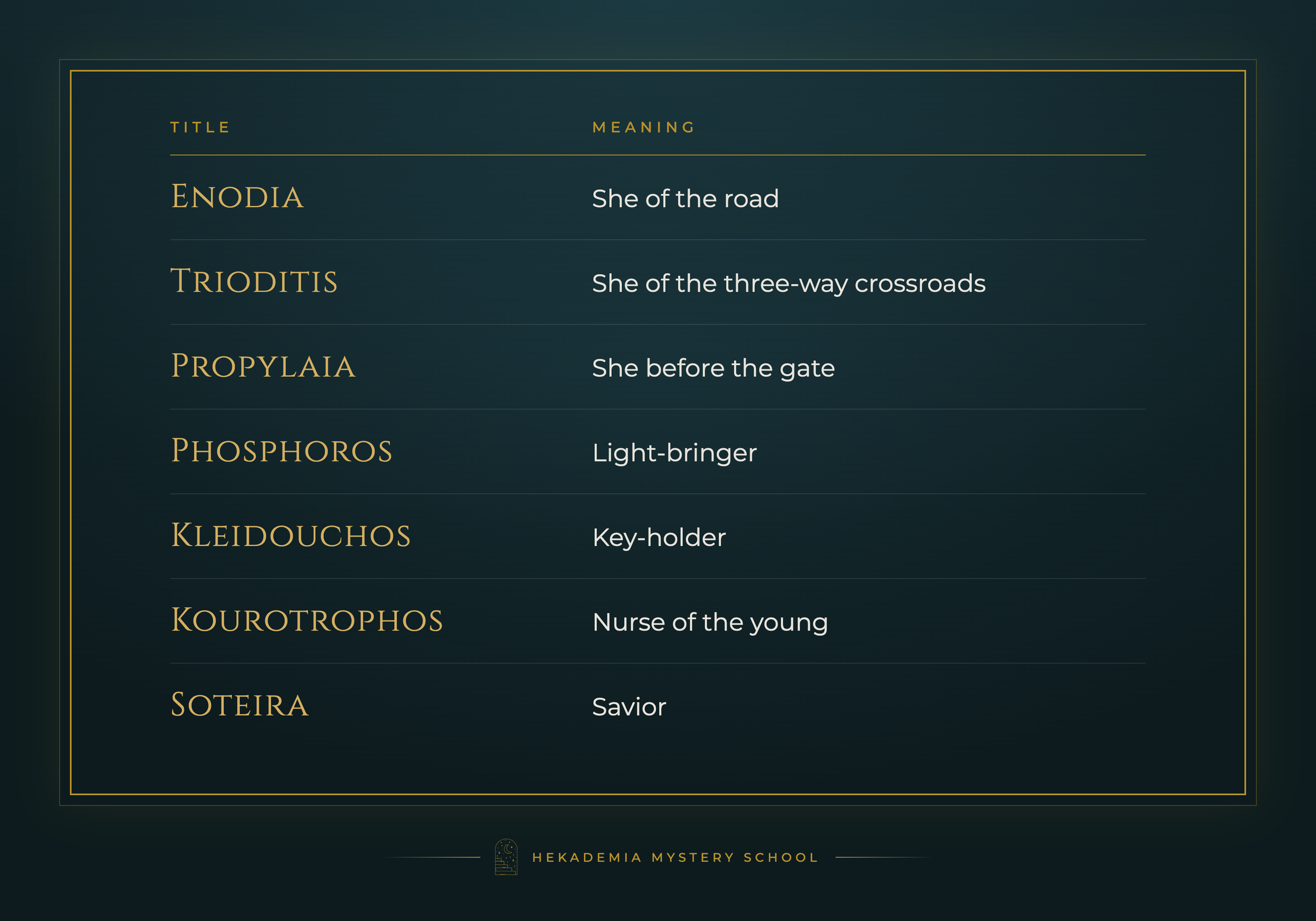
The Greeks called her Trioditis, "she of the place where three roads meet." The Romans called her Trivia, from tri (three) and via (road). Yes, that's where our word "trivia" comes from: the kind of small talk you'd overhear at a busy intersection.
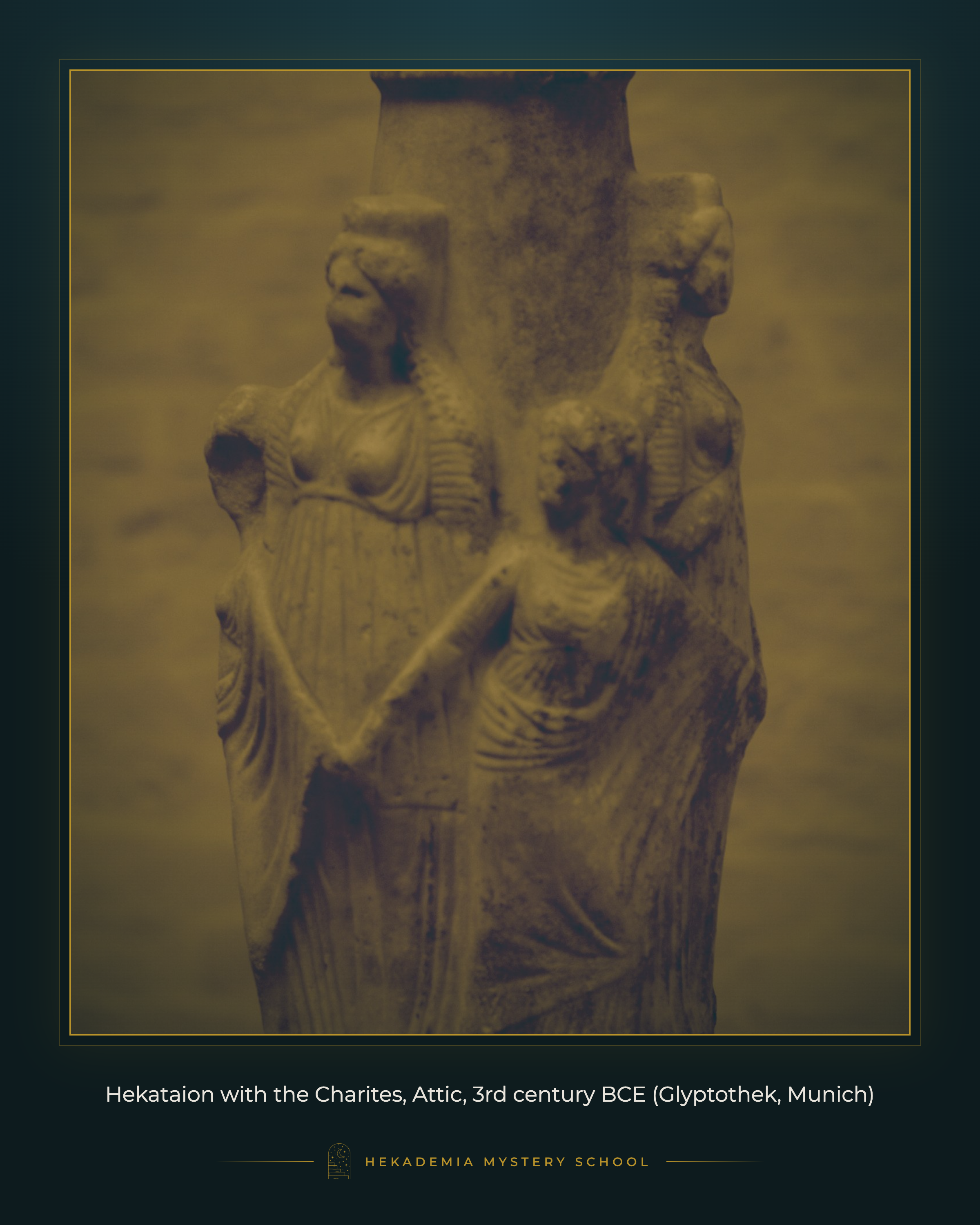
By the fifth century BCE, Athenians were setting up a new kind of image for her. According to the travel writer Pausanias, the sculptor Alkamenes was the first to carve "three images of Hekate attached to one another." His statue, called Hekate Epipyrgidia ("on the tower"), stood at the entrance to the Acropolis beside the little temple of Athena Nike. The original is lost, but copies of this triple Hekate, a hekataion, have survived by the hundreds. Each body faces outward, so the goddess watches every road at once.
These statues stood at crossroads, city gates and the front doors of ordinary houses. The comic playwright Aristophanes jokes that Athenians kept a little shrine of Hekate before every door. She was the guardian of the threshold, the one who decided what passed from outside to inside.
Hekate's Supper
Once a month, at the dark of the moon, Athenian households set out a meal for her at the crossroads. This was the deipnon, "Hekate's supper." It fell on the last night of the lunar month, the in-between night when the old moon has vanished and the new crescent hasn't yet appeared. Houses were swept and purified, the leftovers of the month were carried out, and the family began the new month clean.
The poor knew these meals were there, and quietly ate them. Aristophanes makes a joke of it in his last play, Plutus:
"Ask Hecate whether it is better to be rich or starving; she will tell you that the rich send her a meal every month and that the poor make it disappear before it is even served."
Aristophanes, Plutus (388 BCE)
I love this detail. Hekate's offering fed the hungry. Her worship was woven into how a city cared for the people at its edges.
What the crossroads means
So why her, and why there? Because a crossroads is the purest image of a threshold. It is neither here nor there. It's the place of decision, where one direction closes as another opens. The Greeks believed such places were charged, thin, and open to spirits passing between worlds.
Hekate already moved between earth, sea and sky. She already walked between the living and the dead with Persephone. The goddess of in-between places belongs naturally at the in-between point of every journey. The dark moon is the crossroads of the month. The doorway is the crossroads of the house. And the moment you have to choose a path without seeing where it leads? That's her crossroads too.
Torches, Keys and Hounds: Her Symbols
“Her torch isn’t sunlight. It’s the kind of light you carry into darkness, enough to see the next step.”
Ancient art and ritual gave Hekate a recognizable set of tools. Each one says something about who she is.
The torches. Her oldest and most constant symbol. She lit Demeter's search and Persephone's road. One of her titles is Phosphoros, "light-bringer." Her torch isn't sunlight, which shows everything at once. It's the kind of light you carry into darkness, enough to see the next step.
The key. She was Kleidouchos, "key-holder," and at Lagina her key was carried in procession. A key opens and closes. It decides what is locked away and what is revealed. In the language of a mystery school, it's the perfect symbol: some doors only open when you're ready.
The dogs. Hounds are her sacred animals, and ancient writers describe dogs howling when she draws near. Dogs guard thresholds. They sense what we can't. They're also the animal of Cerberus, guardian of the underworld gate.
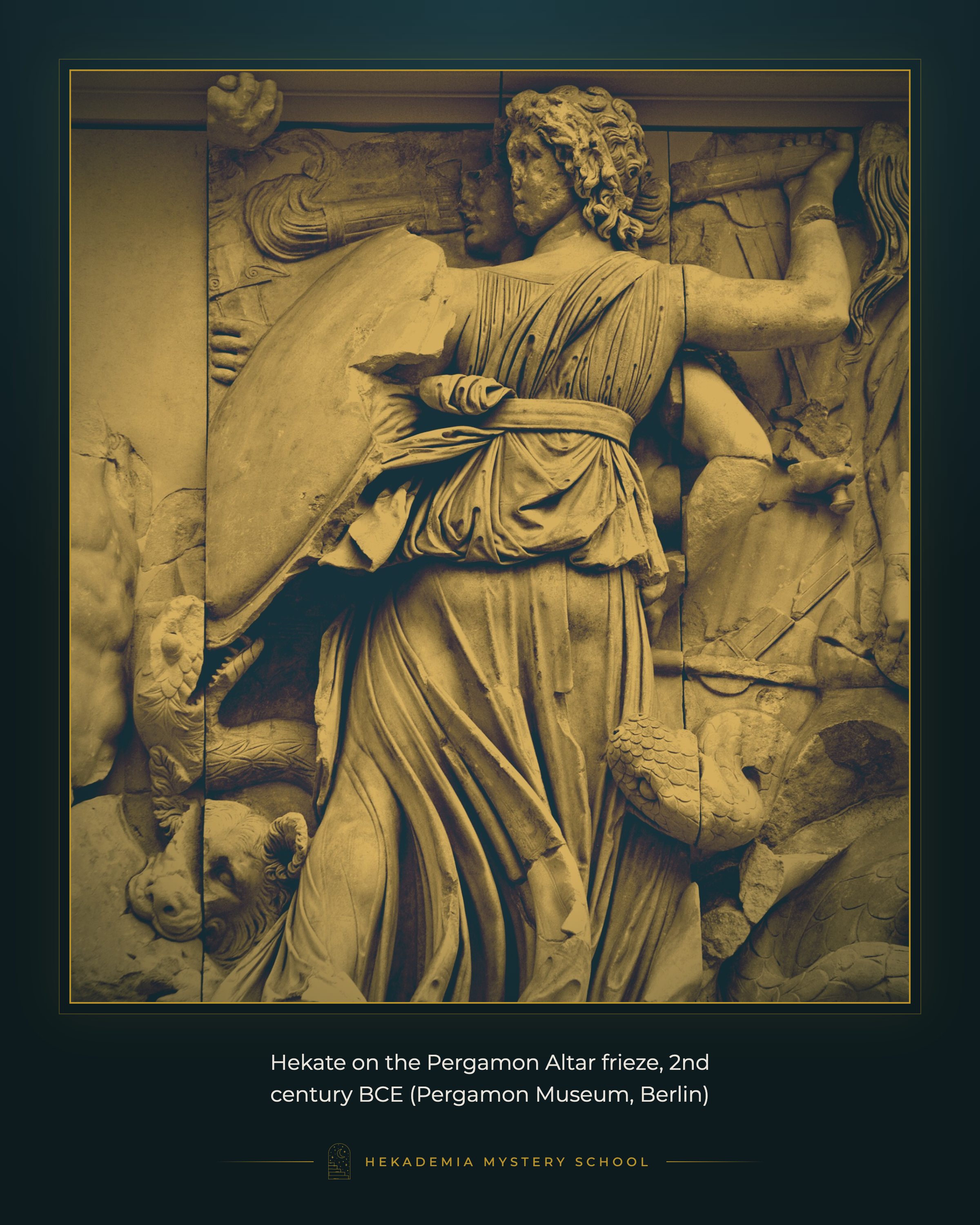
Serpents and the dagger. Later images show her crowned or wreathed with snakes, creatures of the earth that shed their skins and are reborn. Some show a knife, the tool for cutting cords and ritual offerings.
A few of her other titles, all drawn from ancient sources, round out the picture:
Hekate, Goddess of Witches
So how did the generous goddess of Hesiod become the queen of witches? Mostly through Greek tragedy and poetry, starting in the fifth century BCE. As her link to Persephone and the underworld grew, writers leaned into her night side: ghosts, graves, herbs and spells.
Her most famous devotee is Medea, the sorceress princess of Colchis who helps Jason win the Golden Fleece. In Euripides' play Medea (431 BCE), betrayed and furious, Medea swears by her patron:
"By that dread queen whom I revere before all others and have chosen to share my task, by Hecate who dwells within my inmost chamber..."
Euripides, Medea 395 to 397 (trans. E. P. Coleridge, 1906)
Notice where Hekate lives: in the inmost chamber of Medea's house. She's the private goddess of the hearth shrine, the power a woman calls on when no one else will help her.
In the Argonautica of Apollonius of Rhodes (third century BCE), Medea is Hekate's priestess, and she teaches Jason how to summon the goddess. At midnight, alone, he digs a pit by a river and makes an offering. Hekate rises from the depths wreathed in serpents and oak boughs, surrounded by blazing torches, while her hounds howl around her.
The Romans carried this image forward. In Virgil's Aeneid, the Sibyl who guides the hero Aeneas into the underworld says Hekate herself placed her in charge of the sacred groves of Avernus. Earlier in the poem, the dying queen Dido calls on "Hecate whose name is howled by night at the city crossroads" (Aeneid 4.609).
And in the Greek Magical Papyri, the working spellbooks of Greco-Roman Egypt, Hekate is everywhere. Practitioners called on her for protection, for love charms and for help speaking with the dead.
Here's what I find meaningful in all of this. Every one of these stories shows Hekate as the power you turn to at the edge. When the ordinary paths are closed, when you've been wronged, when you need to cross into the unseen, she is the one who answers. That's what a witch goddess really is: the patron of people who have to make their own way.
Hekate as the Soul of the Cosmos
“The goddess who stood between three roads now stands between heaven and earth.”
This is the part of Hekate's story most people never hear, and for a mystery school it may be the most important.
In the second century CE, a father and son known as Julian the Chaldean and Julian the Theurgist produced a mystical poem we now call the Chaldean Oracles. Only fragments survive, quoted by later philosophers. But those fragments became sacred scripture for the Neoplatonists, the last great philosophical school of the ancient world. Some of them ranked the Oracles almost equal to Plato.
In the Oracles, Hekate is no longer a goddess of the roadside. She is cosmic. She stands between the highest, unknowable divine Father and the physical world we live in. She is the membrane between the two, the one through whom the divine ideas flow down into matter and become life. Later writers identified her with the World Soul itself. The scholar Sarah Iles Johnston calls this figure Hekate Soteira, Hekate the Savior.
One fragment, in Thomas Taylor's old translation, describes her body as the source of both souls and virtue:
"In the left hand inward parts of Hecate is the fountain of virtue, which wholly abides within, and does not emit its virginal nature."
Chaldean Oracles (trans. Thomas Taylor, 1797)
Taylor adds that, according to the Chaldeans, her right side holds "the fountain of souls." Every soul, in this vision, is born from Hekate.
See how the whole picture fits together? The goddess who stood between three roads now stands between heaven and earth. The one who walked Persephone down and back up is now the bridge every soul crosses into life, and back again. Her torch becomes the divine light passing down into the world. Her key becomes the means of the soul's return.
The theurgists of late antiquity practiced rituals to make that return journey while still alive. Hekate was the goddess who presided over it. In other words, she was the patron of initiation itself.
Maiden, Mother, Crone? The Honest Answer
If you've spent any time in modern witchcraft, you've probably heard Hekate described as the Crone, the third face of a Maiden, Mother and Crone triple goddess. It's a beautiful framework, and plenty of practitioners work with it meaningfully today. But it isn't ancient.
The Maiden, Mother and Crone triad comes mainly from the twentieth century, especially Robert Graves's The White Goddess (1948), and it spread through modern Wicca and goddess spirituality from there.
In the ancient world, Hekate's three faces meant something different. They looked down three roads. They were about direction and watchfulness, not stages of a woman's life. And when the Greeks and Romans pictured her face, they usually pictured her young. Virgil calls her "threefold Hecate" in the same breath as the "three faces of the maiden Diana." Hesiod's Hekate is a nurse of children, not an old woman.
None of this makes the Crone "wrong" as a way of working with her. Traditions grow. But here in The Library, we want you to know which layer is which, so you can choose consciously. The ancient Hekate is a guardian of thresholds, a light in the dark, a keeper of keys and a cosmic soul. Whatever face you meet her with, that's who is standing at the crossroads.
A Simple Dark Moon Practice: Hekate's Supper
You don't need anything fancy to honor Hekate the old way. The ancient deipnon was a household ritual, done by ordinary families once a month. Here is a simple version, adapted for modern life.
This month the timing is perfect. The dark moon falls on the night of Sunday, November 8, just before the New Moon in Scorpio (late that night in North America, early Monday morning in Europe).
Clear your threshold. During the day, sweep your entryway or tidy the space by your front door. The Greeks purified the house so the new month could begin clean.
Gather what's finished. Take a moment to name what you're done carrying from this past month. A habit, a worry, a story about yourself. Write it on a small slip of paper if that helps.
Set out a small supper. After dark, place a simple offering at a crossroads, at your front door or on your altar. Traditional foods included bread, eggs, garlic, honey and small cakes. Light a candle or a small torch beside it.
Speak to her. Something simple is enough: "Hekate, keeper of the keys, light my way through what comes next."
Walk away without looking back. This is part of the ancient custom. What you've left at the crossroads belongs to her now.
Feed someone. Hekate's suppers fed the poor of Athens. In that spirit, consider a small donation to a local food bank this week. It's one of the most authentic ways to honor her.
If you're traveling or can't leave food outside, an offering on your altar works just as well. Dispose of it the next day, and let the new moon begin.
She Waits Where the Roads Divide
“She doesn’t promise the road will be easy. She offers a light to see the next step and a key for the door in front of you.”
Hekate has worn many faces over three thousand years. The generous Titan of Hesiod. The torchbearer who heard Persephone cry. The triple guardian of Athenian doorways. Medea's patron. The World Soul of the philosophers. Each age found in her what it most needed.
What stays the same is the place you find her: at the edge. At the threshold, the dark moon, the descent, the moment of choice. She doesn't promise the road will be easy. She offers a light to see the next step and a key for the door in front of you.
That is, in the end, what a mystery school is for. Learning to stand at the crossroads without fear, and to see the hidden all around us.
Join the Initiates. Hekademia opens its doors at the Winter Solstice 2026. Join our newsletter for new posts from The Library, practices for the turning of the year, and a few secrets worth keeping.