The Eleusinian Mysteries: The Secret That Was Kept for 2,000 Years
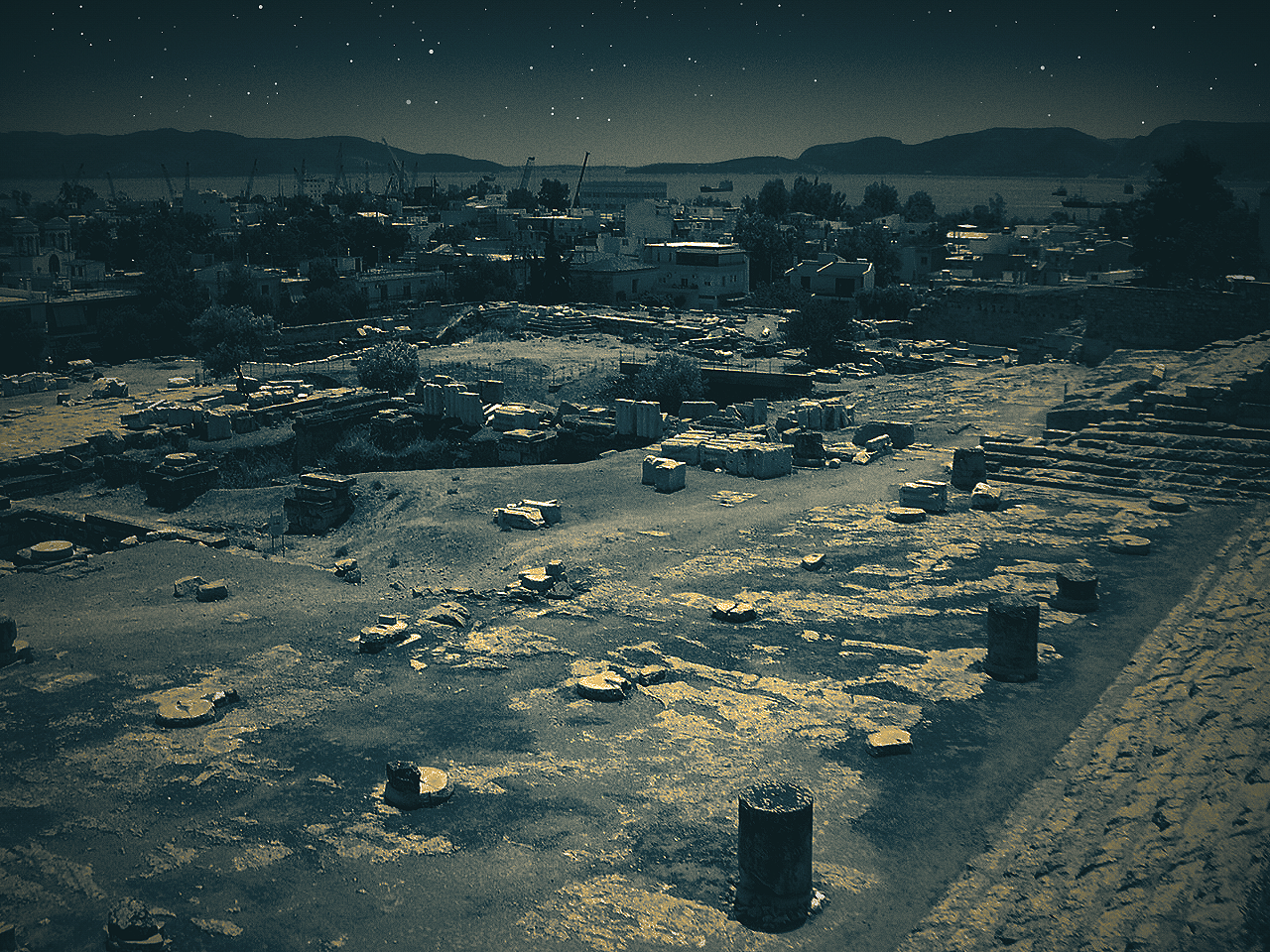
The ruins of the Telesterion at Eleusis.
For roughly two thousand years, people walked about thirteen miles from Athens to a small town called Eleusis to take part in a ritual they were forbidden to describe. Farmers went. Philosophers went. Slaves and emperors went. Women went, at a time when women were shut out of almost everything else.
And almost none of them told.
We know who attended. We know what they ate the night before and which road they walked. We know they came home changed, many of them saying they no longer feared death. What we do not know, even now, is what they saw inside the hall. Thousands upon thousands of initiates kept that secret across twenty centuries, and when the sanctuary finally fell, the secret fell with it.
This is the story of the Eleusinian Mysteries, the most famous mystery school the Western world has ever known. And there is a lovely bit of timing to it: the Greater Mysteries were celebrated in the Athenian month of Boedromion, which falls right around now, in the weeks after the Autumn Equinox. As the year turns toward the dark, it feels like the right moment to walk the Sacred Way together.
The myth at the heart of it: Demeter and Persephone
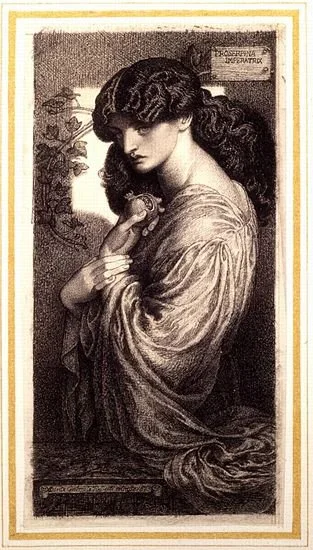
Rossetti's Proserpine (1874), the painting of Persephone holding the pomegranate.
Every mystery begins with a story, and this one begins with a mother and a daughter.
Persephone, also called Kore ("the Maiden"), was gathering flowers in a meadow when the earth split open. Hades, lord of the underworld, rose up in his chariot and carried her down into the dark. Her mother Demeter, goddess of grain and the harvest, heard her daughter's cry and went searching. For nine days she wandered the earth with torches, refusing to eat or bathe.
When she finally learned the truth, that Zeus had allowed the abduction, Demeter withdrew from the gods entirely. Disguised as an old woman, she came to Eleusis and sat grieving beside a well. The royal family took her in as a nurse. A servant named Iambe made her laugh with bawdy jokes, the first crack of light in her grief, and she accepted a drink of barley water flavored with mint. Remember that drink. It comes back.
In her sorrow, Demeter let the fields go barren. Nothing grew. Humanity began to starve, and the gods, who depended on human offerings, finally paid attention. Zeus sent Hermes to bring Persephone back. But before she left the underworld, Hades gave her pomegranate seeds, and because she had eaten the food of the dead, she was bound to return to him for part of every year.
So the seasons were born. When Persephone rises, her mother rejoices and the earth greens. When she descends, Demeter mourns and the land goes fallow. Before she left Eleusis, Demeter revealed her rites to the local nobles and asked them to build her a temple. Those rites became the Mysteries.
Most of what we know of this story comes from the Homeric Hymn to Demeter, composed around the 7th century BCE. The hymn ends with a promise that the initiates would carry for the next thousand years: blessed is the one who has seen these things, and the one who has not will fare very differently in the gloom below.
It is worth sitting with what this myth actually is. It is a story of descent and return. A daughter taken into the dark, a mother's grief so powerful it stops the world, and a reunion that is never permanent. Persephone does not escape the underworld. She becomes its queen. Anyone who has done real shadow work will recognize that shape.
What we know of the rites
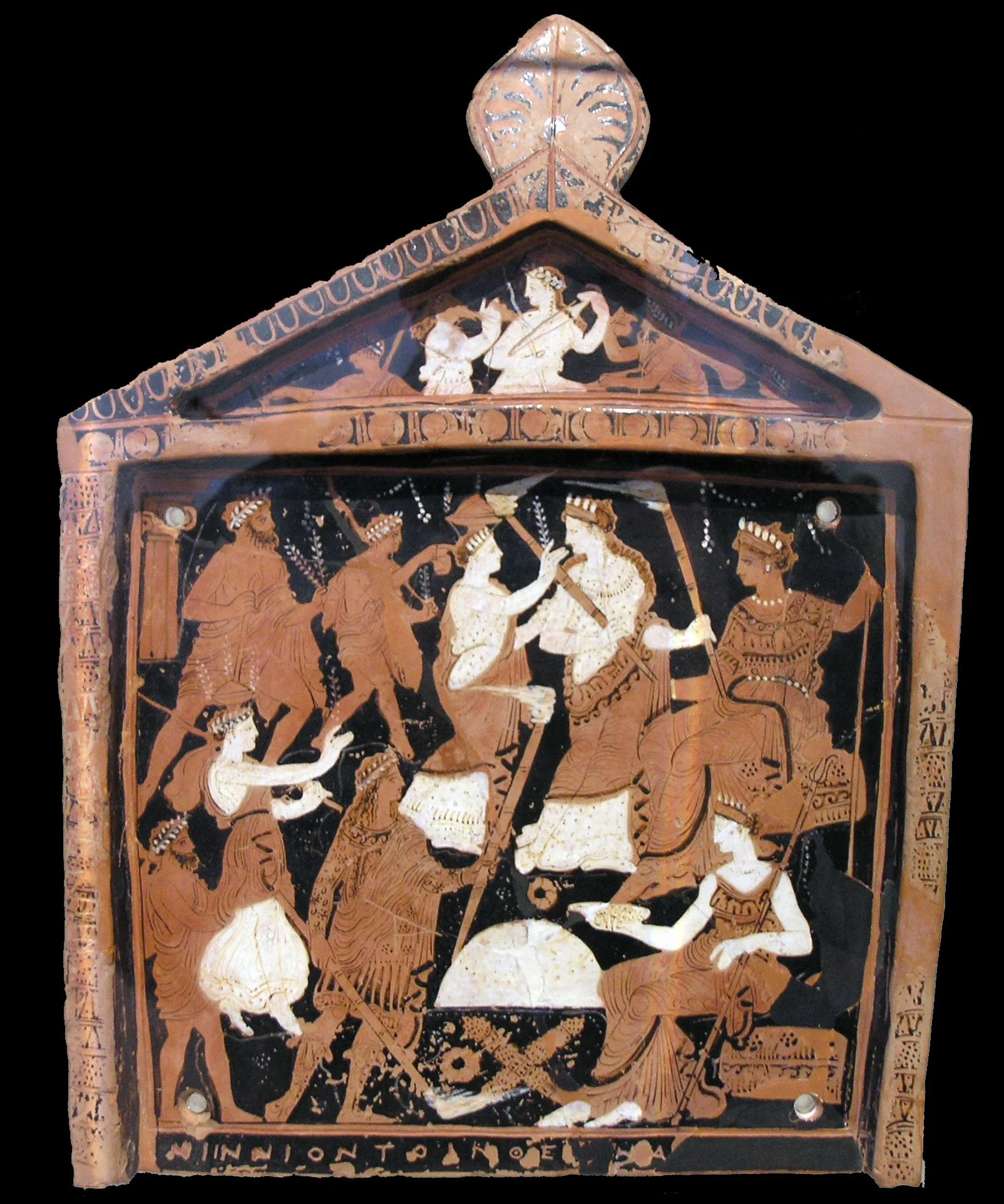
The secret was what happened inside. Almost everything around it was public, and that outer shell tells us a great deal.
the Ninnion Tablet, a painted clay plaque that actually shows an Eleusinian procession. It's one of the only ancient images of the rites
Initiation happened in stages. First came the Lesser Mysteries, held in early spring at Agrae on the edge of Athens, a preparation and purification. Then, months later, the Greater Mysteries in autumn. An initiate at this level was called a mystes, from a root meaning "to close," as in closing the eyes or the lips. Those who returned in a later year could reach the highest grade, epopteia, and become an epoptes, "one who has seen."
The Greater Mysteries unfolded over about nine days, and the broad shape of them goes like this:
The gathering. Sacred objects were carried from Eleusis to Athens. Candidates assembled, and a herald proclaimed who could not take part: anyone with blood on their hands, and anyone who could not speak Greek. Nearly everyone else was welcome, including women and slaves.
"To the sea, initiates!" Each candidate went down to the shore and bathed in the sea with a young pig, which was then sacrificed. A purification of body and spirit.
Fasting and offerings. Days of preparation, abstaining from certain foods, sacrifices to the goddesses.
The procession. Thousands walked the Sacred Way from Athens to Eleusis, crowned with myrtle, carrying torches and calling out to Iacchus. At a bridge along the route, masked figures hurled insults and jokes at the walkers, an echo of Iambe making Demeter laugh.
The night of the Mysteries. The initiates broke their fast with the kykeon, the same barley and mint drink Demeter accepted in her grief. Then they entered the Telesterion, a great hall of initiation, and what happened next is the secret.
The return. Libations poured to the earth, and the initiates went home.
The Telesterion itself was unusual for a Greek temple. Most temples were homes for a god's statue, and worship happened outside. This was a huge, nearly square hall built for thousands of people at once, ringed with tiers of steps and lit by torches, with a small inner chamber called the Anaktoron at its center. Only the Hierophant, the high priest, could enter that chamber. At the climax of the night, ancient sources hint, a great light blazed out of the darkness.
Later writers describe the ceremony in three parts: things done, things said, and things shown. A sacred drama, sacred words, sacred objects revealed. Beyond that outline, the walls held.
How a secret survives two thousand years
Think about how hard it is to keep anything quiet in a small town for one summer. Now imagine a secret shared by hundreds of thousands of people, across Greek and Roman history, and almost no one breaks.
Part of it was law. Revealing the Mysteries was a crime against the state, punishable by death or exile. Athens took it seriously, and a few famous cases show just how seriously.
Aeschylus, the great tragic playwright, was reportedly attacked in the theater when audiences thought one of his plays gave away part of the rites. The story goes that he escaped by arguing he had never been initiated, so he could not have known.
Alcibiades, the brilliant and reckless Athenian general, was accused in 415 BCE of staging a mock version of the Mysteries at a private party. He was recalled from a military campaign to face trial, fled to Sparta instead, and was condemned to death in absence.
Diagoras of Melos, a poet remembered as "the Atheist," was said to have mocked the Mysteries publicly and to have encouraged others not to be initiated. A bounty was placed on his head and he fled Athens.
““Some knowledge is not meant to be read. It is meant to be lived.””
But fear of punishment does not fully explain it. Laws get broken all the time. My own sense, reading the ancient accounts, is that the deeper reason was the nature of the experience itself.
Aristotle, as quoted by a later writer, said that initiates did not come to learn something but to experience something and be changed by it. If that is true, then the secret was never really a piece of information. It was an encounter. You could describe the objects and the words and still give away nothing, the way telling someone about a ceremony is nothing like sitting in one. Some things can only be passed on by walking someone to the door.
And those who walked through spoke of it with reverence. Cicero, a Roman statesman and initiate, wrote that Athens gave the world nothing finer than these Mysteries, through which people learned to live with joy and to die with a better hope.
So what actually happened in there?
A sacred drama. Many scholars believe the initiates witnessed, or even moved through, a ritual reenactment of the myth: Demeter's torchlit search, Persephone's descent, and her return. Walking through grief in the dark and arriving at a reunion in blazing light would be a powerful thing to live through in your body, not just hear about.
The things shown. Our most specific clues come, ironically, from early Christian writers who were hostile to the Mysteries and wanted to expose them. One of them, Hippolytus, claimed that the highest revelation was a single ear of grain, reaped in silence. Another, Clement of Alexandria, recorded what seems to be an initiate's password: a sequence about fasting, drinking the kykeon, and handling objects taken from a sacred chest and basket. These writers had every reason to make the rites sound silly, so we hold their accounts loosely. Still, an ear of grain makes beautiful sense. The seed goes into the dark earth, seems to die, and rises again. That is Persephone's story in miniature, and perhaps the initiate's own.
The kykeon. This is where the theories get spicy. In 1978, three researchers, the mycologist R. Gordon Wasson, the chemist Albert Hofmann (the man who first synthesized LSD), and the classicist Carl Ruck, published The Road to Eleusis. They proposed that the barley in the kykeon may have been infected with ergot, a fungus that grows on grain and contains compounds chemically related to LSD. In their view, the visions of Eleusis were entheogenic, a sacred encounter brought on by a plant medicine.

No one knows for certain. But the fragments we do have point in a few intriguing directions, and the honest answer is probably some combination of them.
Köhler's Medicinal Plants in Life-like Illustrations
The idea has gained new attention in recent years, notably through Brian Muraresku's 2020 book The Immortality Key. It is also still very much a hypothesis. Critics point out that ergot is dangerously toxic and hard to prepare safely, and there is no direct chemical evidence from Eleusis itself. We simply do not have a residue sample from the Telesterion.
I will be honest about why this theory moves me. My life has been shaped by plant medicine in the Shipibo tradition, and when I read descriptions of initiates fasting, purifying, drinking a sacred brew at night, and emerging no longer afraid of death, something in me recognizes it. But recognition is not proof, and a mystery school worth its name should be careful with the difference. What we can say is that the ancient world understood something many modern people are only rediscovering: that ceremony, preparation, community, and the sacred can open a door that ordinary life keeps shut.
The night the door closed
The Mysteries outlasted kingdoms. They survived the Persian Wars, the rise and fall of Athenian power, Alexander, and Roman conquest. Roman emperors, including Hadrian and Marcus Aurelius, came to be initiated themselves. By some estimates the rites ran from the Mycenaean age, around 1500 BCE, all the way into the late 4th century CE. Roughly two thousand years of the same ceremony in the same place.
Then the world changed. As Christianity became the official religion of the Roman Empire, Emperor Theodosius I issued a series of decrees in the 390s CE banning pagan worship and sacrifice. The sanctuary at Eleusis was closed. In 396 CE, Gothic forces under Alaric swept through Greece and the site was sacked, and it was never restored.

Evelyn De Morgan's Demeter Mourning for Persephone
The ancient writer Eunapius tells a haunting story about this ending. He says the last legitimate Hierophant foresaw that the temples would be destroyed and that he would be the final priest to serve there. Whether or not that prophecy was real, the outcome was. The line of priests was broken, the hall fell silent, and the people who carried the secret died with it.
That is the strange beauty of it. The Eleusinian secret was never discovered. It was kept until there was no one left to keep it.
Why Eleusis still matters
It might seem odd to begin a modern mystery school with a story about a secret we can never recover. But I think it is the only honest place to start.
Eleusis teaches that some knowledge is not meant to be read. It is meant to be lived. The initiates were not handed answers. They were prepared, purified, walked down a long road with their community, and brought into the dark so they could witness the light. They were changed by experience, and the experience belonged to them.
It also reminds us that the Wheel of the Year is older and deeper than any one tradition. Long before anyone wrote down the names Mabon or Samhain, people in Greece were marking the turn toward autumn with a story about a daughter who goes below and a mother who grieves. The descent into the dark half of the year was sacred to them. It can be sacred to us too.
And Persephone herself is one of the oldest faces of what we now call the dark feminine. She is the maiden who was taken and returned as a queen. She did not avoid the underworld. She learned to rule there. That is the work so many of us are doing now, in shadow work, in ceremony, in the quiet seasons of our own lives.

Frederic Leighton's The Return of Persephone
That is the spirit Hekademia is built on. We cannot rebuild the Telesterion, and we would not pretend to. What we can do is study the old ways with care, practice with the seasons, and make room for the kind of learning that happens in the body and the soul, not just the mind.
The door at Eleusis closed sixteen centuries ago. The mysteries themselves never left.
Hekademia Mystery School opens at the Winter Solstice 2026. Join the list to be the first to walk through the door.