We Used to Know This
I have a confession about the retreats I lead with Gaian Rhythm. My talk on seasonal alignment is a little like a timeshare meeting. People come for the ceremonies, and without quite realizing it, they've gathered with us on one of the great turning points of the year. Then, once I have them, I pull out my slideshow. That's my true purpose. That's the thing I hope they carry home.
Somewhere in that slideshow there's an image of people dancing beneath the sun, and when it comes up I always say the same thing: I am not teaching you anything new. I didn't make any of this up. This is the oldest knowledge we have.
“I am not teaching you anything new. This is the oldest knowledge we have.”
People celebrated the movement of the sun and the stars for thousands of years. Not because they were ignorant or primitive, but because they understood that the sky and the seasons were a reflection of them.
Samhain is one of those moments. And if you look past the Celtic version most of us know, you find something remarkable: all over the world, in cultures that never met each other, people do almost the same things at this time of year. They feed their dead. They light fires. They say the boundary between worlds grows thin.
This post is a walk through those mid-autumn rites, across cultures and across time, and an invitation to notice why they keep showing up. At the end you'll find a few simple practices for your own season of the dead.
Where Samhain Sits in the Year
Samhain marks the end of the harvest and the beginning of winter, the dark half of the year. In the old Gaelic calendar it was one of four great seasonal festivals, alongside Imbolc, Bealtaine and Lughnasa. Because the Celtic day began at sunset, the festival opened on the evening of October 31.
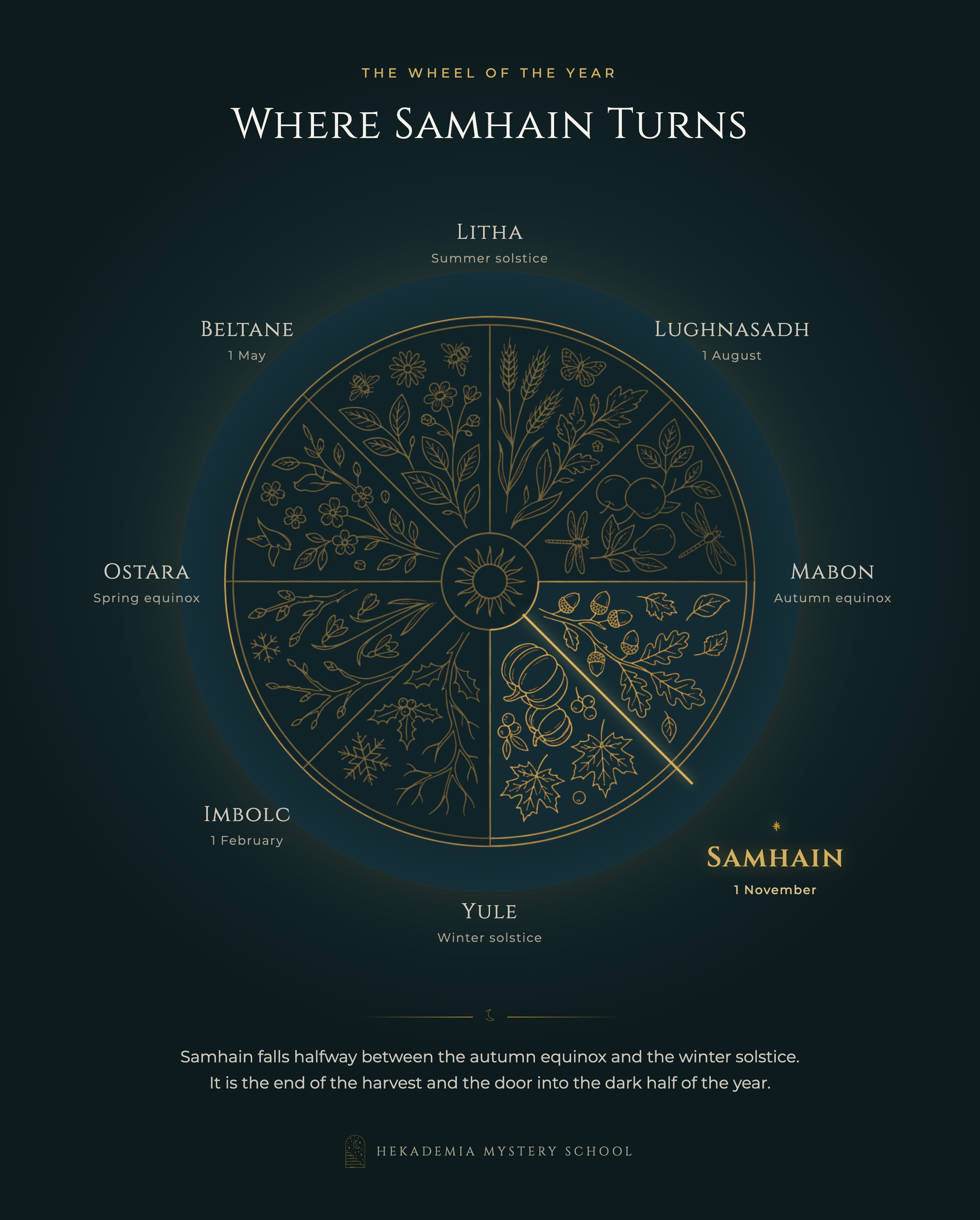
It isn't a solstice or an equinox. It is a cross-quarter day, falling roughly halfway between the autumn equinox and the winter solstice. If you measure it by the sky rather than the calendar, that midpoint lands around November 6 or 7, when the Sun reaches 15° Scorpio. Many people celebrate on that date for exactly that reason. Either way, Samhain sits in the heart of Scorpio season, the sign of death, depth and what lies beneath. As above, so below.
The sky was only part of it, though. Samhain was also the moment the cattle came down from summer pastures and the herders chose which animals would be slaughtered for winter. The harvest was in. The fields were going bare. The nights were winning. Everything people could see around them was dying back into the earth.
And people noticed the sun long before anyone wrote about it. Some Neolithic passage tombs in Ireland, including the Mound of the Hostages on the Hill of Tara, are aligned with the sunrise around the time of Samhain and Imbolc. Those tombs are thousands of years older than any written word about this festival. Before there was a name for it, someone was watching the light enter the house of the dead on these mornings.
That is the season. Now look at what people all over the world have done with it.
Feeding the Dead
The most common thing humans do in this season is cook for people who are no longer here.
India: Pitru Paksha. For sixteen lunar days in September or October, Hindus honor their ancestors with food offerings in a rite called shraddha. Rice balls mixed with ghee and black sesame are offered with water poured from the hand. Food is set out on the roof, and if a crow comes to eat it, the offering has been accepted. What strikes me most is the timing. Most years the autumn equinox falls inside this fortnight, and in Hindu tradition the southern half of the sky belongs to the ancestors. When the Sun crosses into it, the days of the dead begin. That is a solar holiday in the most literal sense.
There's a beautiful story behind it, from the world of the Mahabharata. When the hero Karna died and rose to heaven, he found himself starving, because every bit of food he touched turned to gold. He had given away gold his whole life, but he had never fed his ancestors. So he was allowed to return to earth for fifteen days to make it right. Those fifteen days became Pitru Paksha.
Cambodia: Pchum Ben. Its name means something like "gathering of rice balls." It's a fifteen-day festival that ends at the close of the Buddhist rains retreat, when Cambodians honor relatives going back as many as seven generations. Monks chant through the night before the gates of the underworld open, and people offer food to help the dead who are still suffering. In many temples, people throw rice balls into the air or scatter rice across an empty field for them.
China: Chung Yeung. The Double Ninth Festival falls on the ninth day of the ninth lunar month, which lands on October 18 this year. Its origins reach back roughly two thousand years. People climb mountains, drink chrysanthemum wine, and in Hong Kong and Macau, whole extended families go to the graves of their ancestors. They clean the stones, repaint the names, and lay out food. Once the spirits have taken the essence of the meal, the living eat it together.
Mexico: Día de Muertos. On November 1 and 2, families build ofrendas, altars loaded with the favorite foods and drinks of the people they've lost, along with photos, candles and orange marigolds whose color and scent are said to guide the dead home. Pillows and blankets are sometimes left out so the dead can rest after the long journey. Historians argue about how much of this is Indigenous and how much came from Spanish Catholicism, and the honest answer is probably both. The Aztecs did hold a festival called Quecholli between late October and early November that included placing food near the graves of warriors.
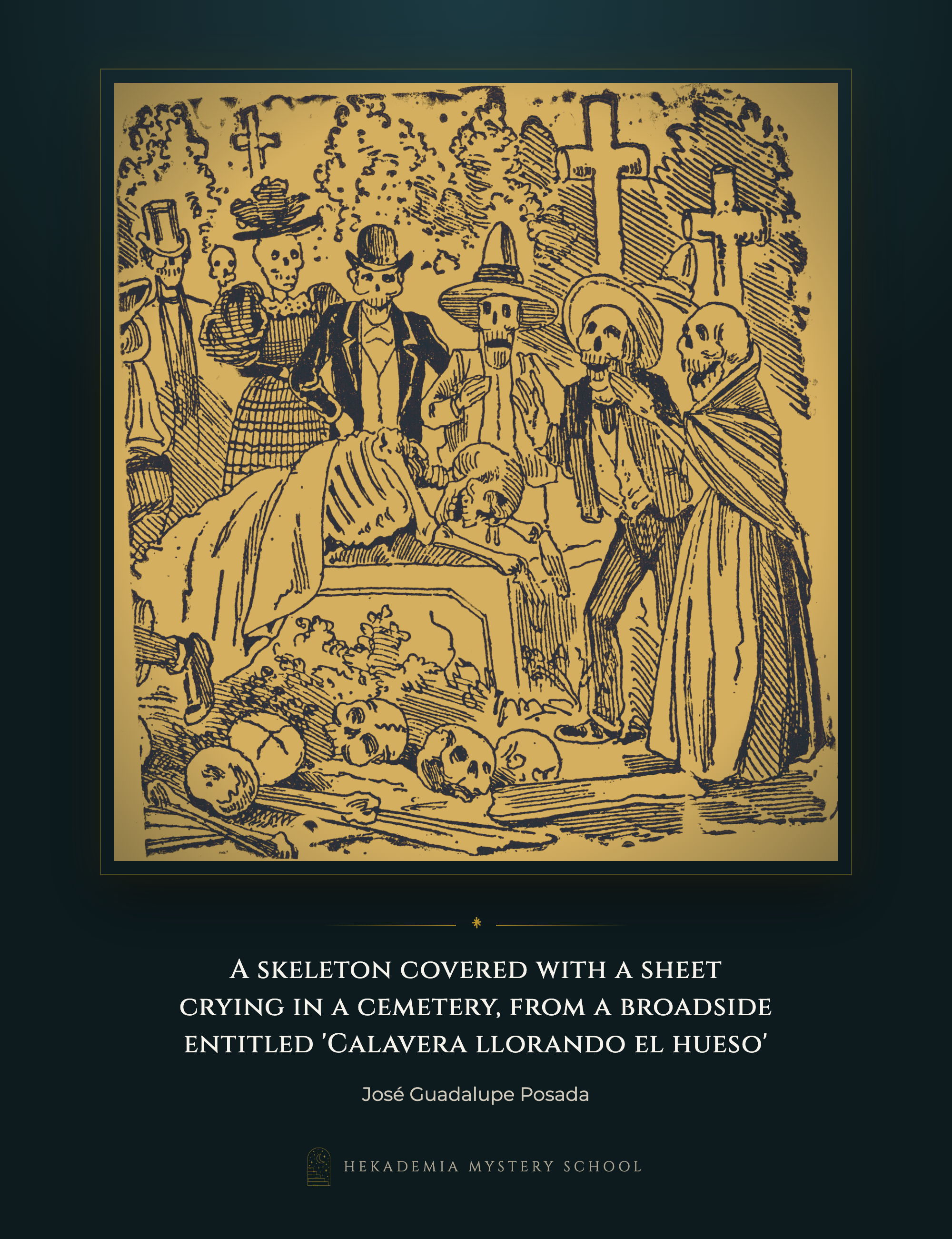
Ireland and Scotland. In the Gaelic world, the souls of the dead were believed to come home at Samhain looking for hospitality. Families set a place at the table and by the fire for them.
Five cultures. Different gods, different calendars, different continents. The same meal set out for the same guests.
“Different gods, different calendars, different continents. The same meal set out for the same guests”
When the Boundary Opens
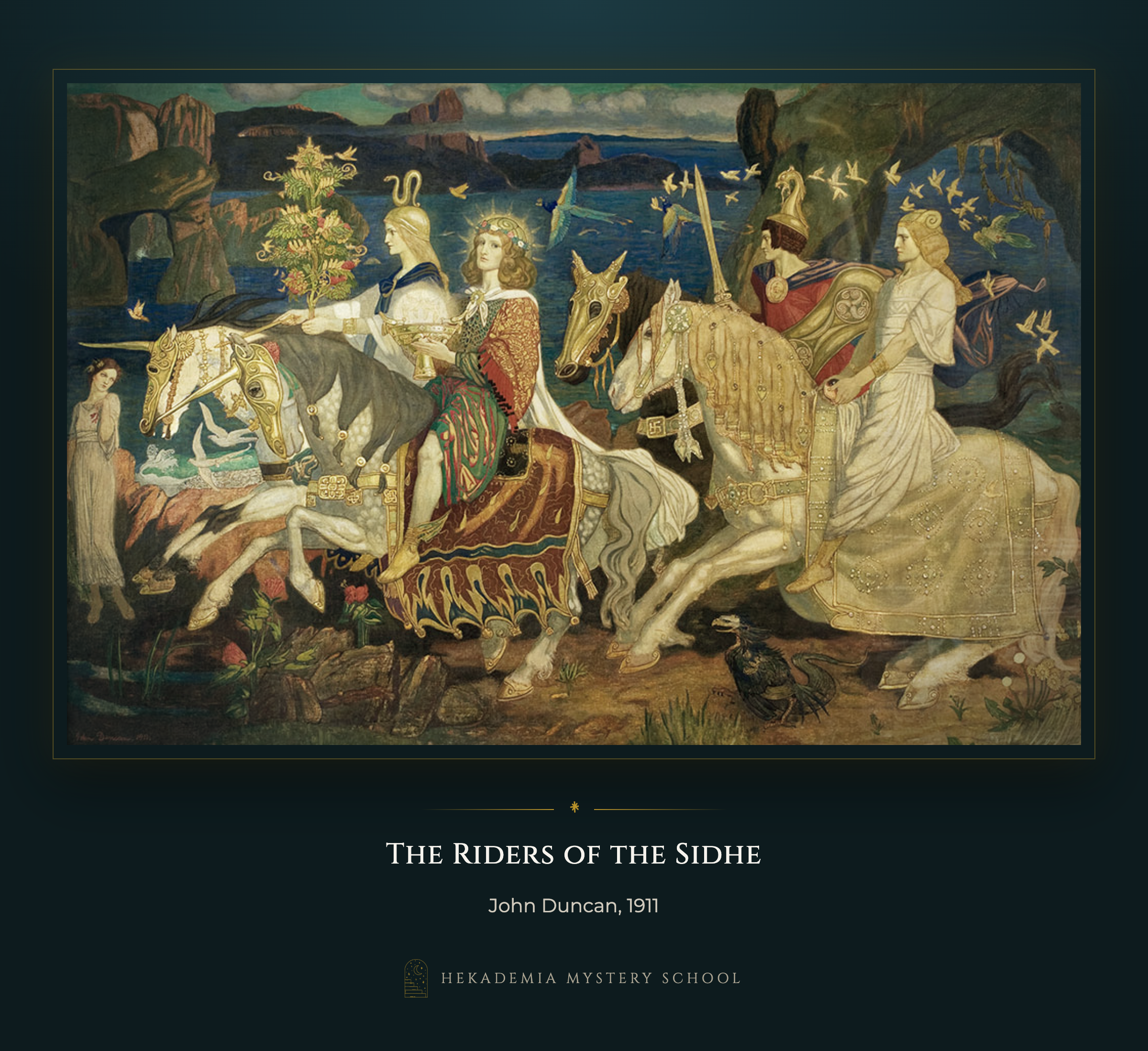
The second pattern is the belief that at this turning of the year, the wall between our world and the other one gets thin.
Ireland: the mounds open. The medieval Irish tales, written down from the 9th century onward, say the sídhe, the ancient burial mounds and doorways to the Otherworld, stood open at Samhain. In Echtra Nerai (The Adventure of Nera), a king dares his warriors to go out on Samhain night and tie a band around the ankle of a hanged man. Only Nera succeeds. The dead man speaks and asks for a drink. Later Nera follows a host of spirits through a mound into the Otherworld, where he learns that what he saw was a vision of disaster coming the following Samhain. On this one night, the dead talk, the hills open, and you can see the future.
Scandinavia: the Winter Nights. The Norse divided the year into two halves, summer and winter, and the Winter Nights in mid to late October opened the dark half. It was a festival of feasting and sacrifice, and the Old Norse sagas describe it as a dangerous time when supernatural beings roamed. Offerings were made to the dísir, female spirits tied to fate, and the sagas tell of people dreaming at this season of women who revealed their future, often their death. One 11th century poem records a skald being turned away from a farm because the family inside was holding an álfablót, a sacrifice to the elves, and the house had been declared holy.
Even the Anglo-Saxons, according to the monk Bede, began their winter half of the year with an autumn month called Winterfylleth. Scholars think it may share a root with the Norse Winter Nights in some older calendar.
Christian Europe: All Souls. Around the year 1000, the abbey of Cluny in France set November 2 as a day to pray for all the dead, and the date spread across Western Christianity. The folk customs that grew around it would be familiar to anyone in this post. In Tirol, families left cakes on the table for their departed and kept the room warm for them. In Brittany, people knelt at the graves at nightfall and poured out milk, then left supper on the table for the souls when they went to bed.
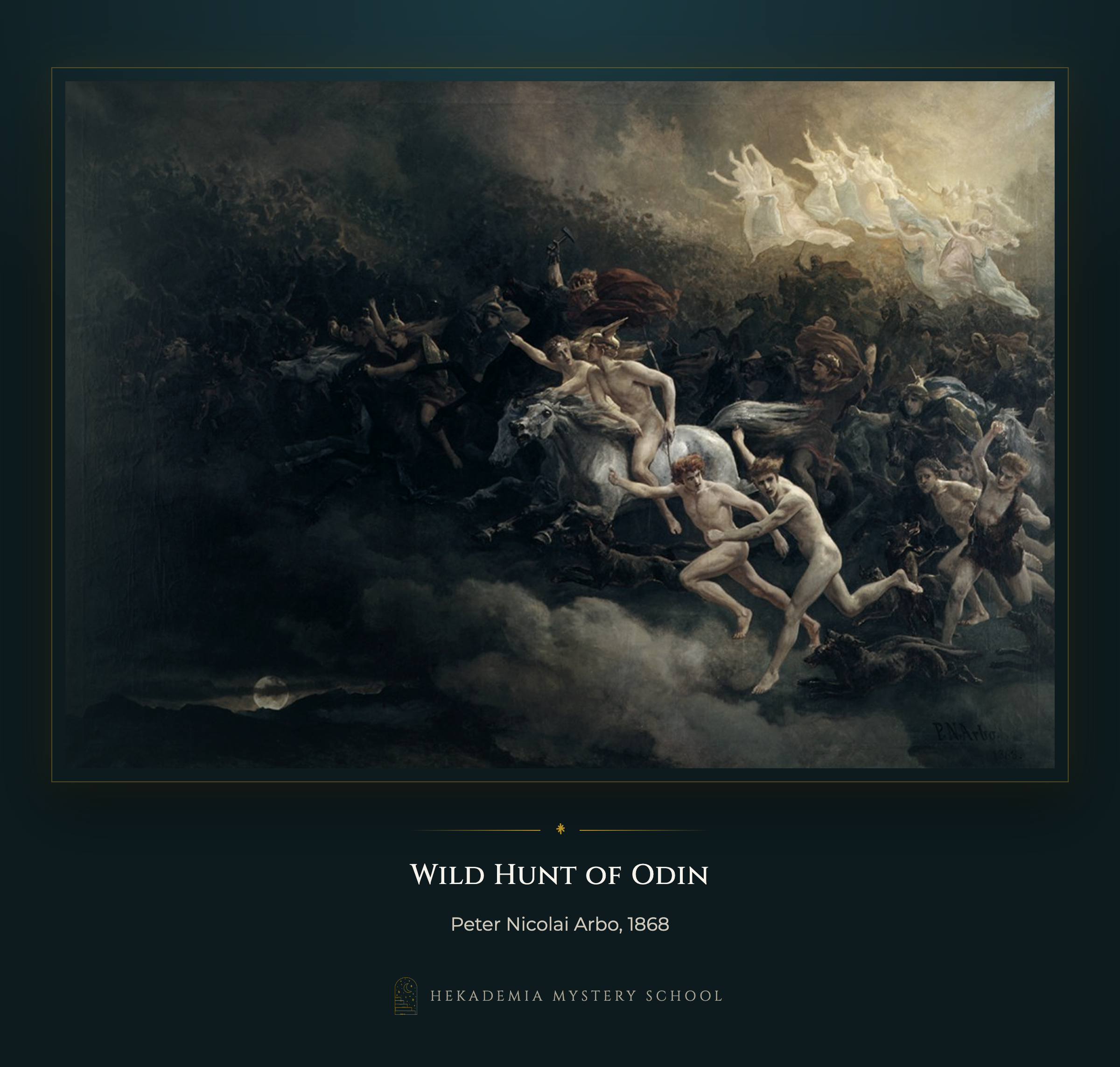
Different theologies entirely. Purgatory, Pitriloka, the sídhe, the dísir riding out in the dark. And yet every one of them says the same thing about this season: the dead are close, and they are listening.
Fire Against the Dark
The last pattern is the simplest. When the light leaves, people make their own.
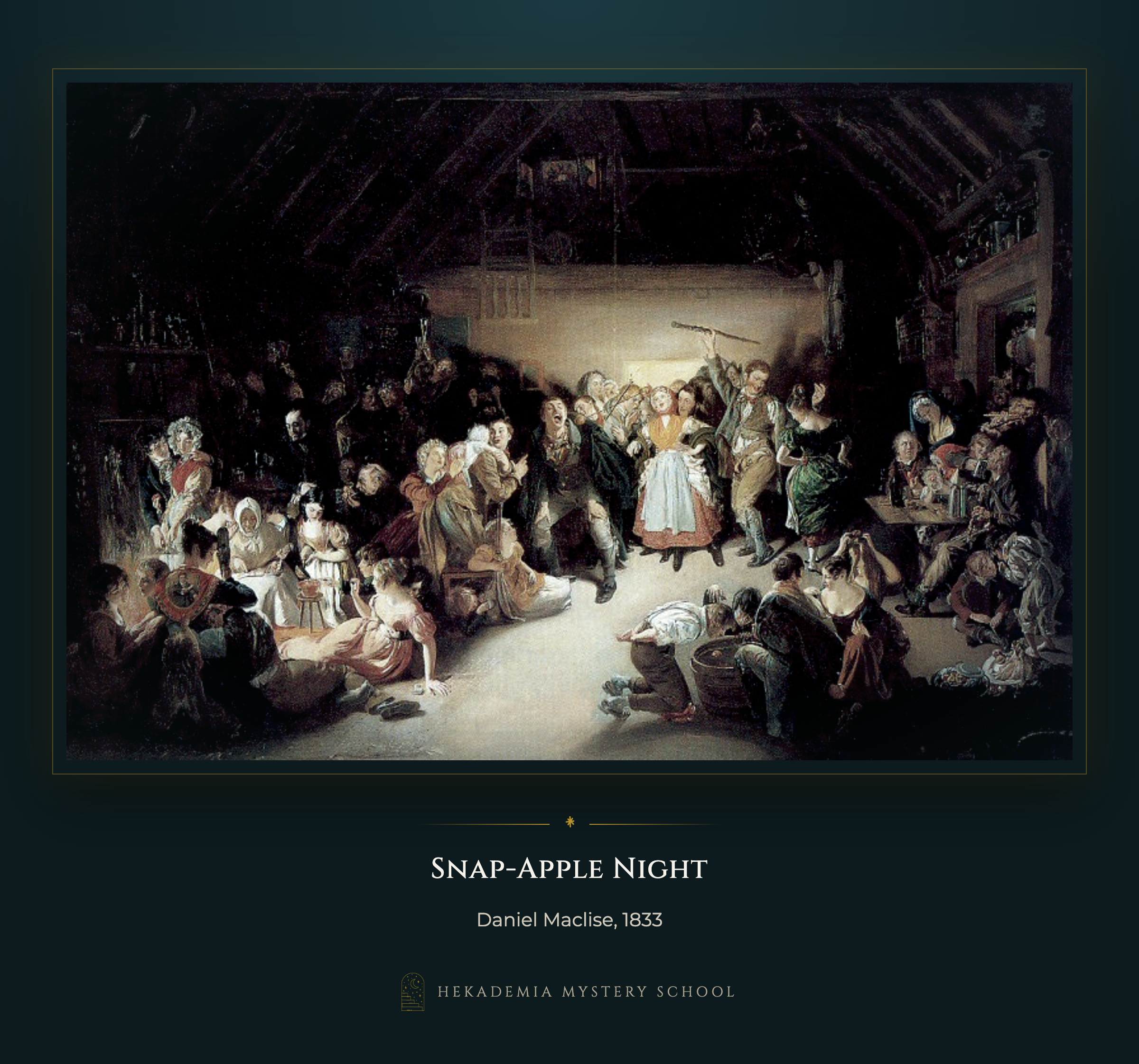
Ireland and Scotland: the Samhain fires. Bonfires were lit on hilltops at Samhain, and the medieval tales mention them too. In parts of Ireland and Scotland, families put out their hearth fires on Samhain night and then relit them from the great communal bonfire, so that every home in the village carried the same flame into winter. In some places, people and their animals walked between two bonfires to be cleansed. In 19th century Scotland, torches were carried sunwise around homes and fields for protection. Folklorists have long read these fires as a kind of sympathetic magic: making a small sun on the ground to help the real one through the dark.
India: Diwali. The festival of lights falls between mid-October and mid-November, and its heart is the darkest night of the month, the new moon. That night, homes and temples are lined with rows of little oil lamps called diyas. One early text describes those lamps as pieces of the sun, the giver of light and life, at the time of year when the sun is changing. Diwali also carries the dead within it. On one night of the festival, a single lamp is set facing south at the back of the house for Yama, the god of death. And one scholar describes the lights of Diwali as a farewell to the ancestors who were welcomed home a few weeks earlier, during Pitru Paksha.
Think about that for a moment. The ancestors come home at the equinox. They are fed for two weeks. Then, on the darkest night of the following month, the whole country lights their way back.
Europe: Martinmas. On November 11, the feast of St. Martin marked the end of the harvest and the start of winter across much of Europe. In the Rhineland, so many bonfires burned on St. Martin's Eve that the festival was once nicknamed "spark day," and people jumped through the flames and spread the ashes on their fields. Children in Germany and the Netherlands still walk through the dark carrying lanterns, once carved from turnips and beets. In parts of Portugal, families roasted chestnuts on the fire and set a table of them at midnight for their dead.
From a hilltop in Meath to a rooftop in Varanasi to a village street in the Rhineland, people have answered the lengthening nights the same way. They lit something, together, and carried it home.
What Isn't Ancient
This is The Library, so we owe you the honest version. A lot of what gets passed around about Samhain every October is much younger than it claims to be.
There was no "Samhain, Lord of the Dead." That god was invented in the 18th century by Charles Vallancey, a British military surveyor in Ireland with big theories about Irish history. He rejected the established meaning of the word and claimed Samhain was a Celtic death god. His contemporaries mocked his scholarship, but his books ended up in libraries anyway, and the made-up deity has haunted Halloween writing ever since.
"The Celtic New Year" is a theory, not a record. The idea came from the scholar John Rhys in the late 19th century and was popularized by James Frazer in The Golden Bough. The medieval Irish texts do list Samhain first among the four seasonal festivals, which is suggestive. But the historian Ronald Hutton calls the evidence for a Celtic new year flimsy.
We know very little about pagan religious rites at Samhain. The medieval tales describe feasts, assemblies, fires, and the Otherworld breaking through, but Hutton points out that none of them actually depicts a pagan ritual. The one account of druids lighting a sacred fire at Tlachtga comes from Geoffrey Keating, writing in the 1600s from sources no one can identify. Hutton even suggests the tales may be set at Samhain simply because a great gathering made a good backdrop, the way so many Arthurian stories happen at Christmas court. Most of the "ancient Samhain rituals" you'll find online are modern, created by 20th century Wiccans and neopagans. That doesn't make them less meaningful. It just makes them new.
Even "the veil is thinnest" is the modern way of saying it. That phrasing is how contemporary Wicca describes Samhain. The older Irish image is more physical and, honestly, more striking: the hills themselves open, and the people inside walk out.
Not every holiday is a pagan one in disguise. Samhain and the Christian feasts of All Saints and All Souls clearly shaped each other, and the influence ran in both directions. Some scholars think Samhain's role in creating Halloween has been exaggerated. As we saw, historians are also divided on how much of Día de Muertos is Indigenous and how much is Spanish Catholic.
Here's why none of this weakens the point of this post. It strengthens it. You don't need a secret line of druids passing down the same ritual for three thousand years to explain why the world honors its dead in autumn. You only need people, paying attention to the same sky and the same dying fields, again and again.
Why This Keeps Happening
So why do people in India, Ireland, Cambodia, Mexico and Iceland all end up doing the same things at the same time of year?
Because the season does something to us. It always has.
We built "inside." Inside isn't real, not really. There is only outside, only the world. But we built inside, and we filled it with heat and air conditioning and lights and curtains, and now we decide what season it is all the time. We stopped observing nature, and so we forgot that we are a part of it.
But listen to the way we still talk. Spring fever. The dog days of summer. Seasonal depression. We say these things without realizing what we're describing: our own connection to the seasons, still running underneath everything, whether we notice it or not. When the earth wakes up from her slumber and everything is coming to life, seeds sprouting all around you and the sun dominant in the sky, it does something to you. It's telling you that now is the time to take action.
And when the fields go bare, the leaves come down, and the dark starts winning? That does something to you too. It turns you inward. It makes you think about what's ending. It makes you think about the people you've lost. Every one of the traditions in this post is a culture listening to that feeling and giving it a shape: a table set for the dead, a lamp in the window, a door left open for the ones coming home.
The Hermetic teachers had a phrase for this, the one we explored in As Above, So Below. The pattern in the sky and the land is the same pattern in us. Samhain is when the outer year descends into the underworld, and it is the natural time for us to go down too. Into grief. Into memory. Into the shadow, the parts of ourselves we keep in the dark. It's no accident that this season belongs to Scorpio, the sign of death, depth and transformation.
I am not teaching you anything new. I didn't make any of this up. This is the oldest knowledge we have. We used to know it. We can know it again, simply by paying attention.
Simple Practices for Your Season of the Dead
You don't need to belong to any of these traditions to honor this time of year. Each practice below borrows the spirit of the old rites, not the rites themselves. Choose one, or let them carry you from Samhain through the astronomical midpoint around November 7.
Build an ancestor altar. Clear a small surface and add photos of people you've lost, something that belonged to them, a candle, and a bit of their favorite food or drink. It doesn't have to be family by blood. Teachers, friends, and animals who shaped your life belong here too. Sit with it for a few minutes each evening and talk to them out loud, the way families do at their ofrendas.
Set a place at the table. Hold a dumb supper: a meal eaten in silence with an empty chair and a full plate for the dead. If silence through a whole dinner feels like too much, simply set the extra place and say who it's for before you eat. Afterward, take the food outside and leave it for the birds, the way the shraddha offering is left for the crows.
Light a candle in the window. On Samhain night, put a candle in a window facing west, the direction of the setting sun, to light the way home for anyone who's looking for you.
Tend a grave, or a memory. Like the families at Chung Yeung, visit a grave if you can. Clean it, bring flowers, sit for a while. If the people you love are far away or were never buried, write their names somewhere you'll see them and keep that space clean through the season.
Write it down and give it to the fire. Ask yourself what in your own life is finished. A habit, a story about yourself, a grief you've carried long enough. Write it on paper and burn it in a fire pit or a safe bowl. Then light one fresh candle from that flame and carry it into your home, the way Gaelic families relit their hearths from the communal bonfire.
Walk and notice. Go outside, wherever you are, and look for what is dying back. Leaves, stalks, the last of the garden. Don't try to make it mean anything at first. Just notice. That attention is the whole practice, and it's the oldest one there is.
A note for readers in the Southern Hemisphere: your season of the dead arrives around May 1, when your own autumn turns toward winter. Follow your sky, not the calendar.
Join the Initiates
Hekademia Mystery School opens its doors at the Winter Solstice, when the longest night turns and the light begins to return. Until then, The Library is where we're sharing what we study: the turning of the Wheel, the moon and the stars, and the old mysteries that keep finding their way back to us.
If this spoke to you, join the Initiates. You'll get new posts from The Library, word of each new moon, full moon and season as it arrives, and a few secrets worth keeping, along with first notice when the doors open.
Join the Initiates
Sources
Celtic and Gaelic
Samhain, summarizing Ronald Hutton, The Stations of the Sun (1996); Kevin Danaher, The Year in Ireland (1972); F. Marian McNeill, The Silver Bough (1961); and the medieval tales Echtra Nerai, Serglige Con Culainn, Tochmarc Emire and Cath Maige Tuired
Was There an Irish God Named Samhain?, Irish Myths
6 Facts About Samhain, Mental Floss
Halloween in the Stars, WMRA (cross-quarter timing)
Asia
Americas
Northern Europe and Christian Europe
Winter Nights, drawing on Terry Gunnell, "The Season of the Dísir" (2000)