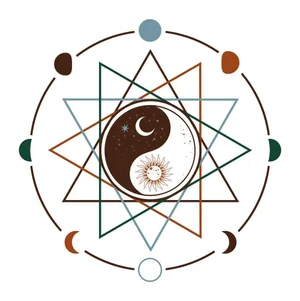
You have probably seen it somewhere. Inked on a forearm, printed on the back of a tarot deck, tucked into a caption under a photo of the full moon. As above, so below. Four words that feel ancient and true even before you know where they come from.
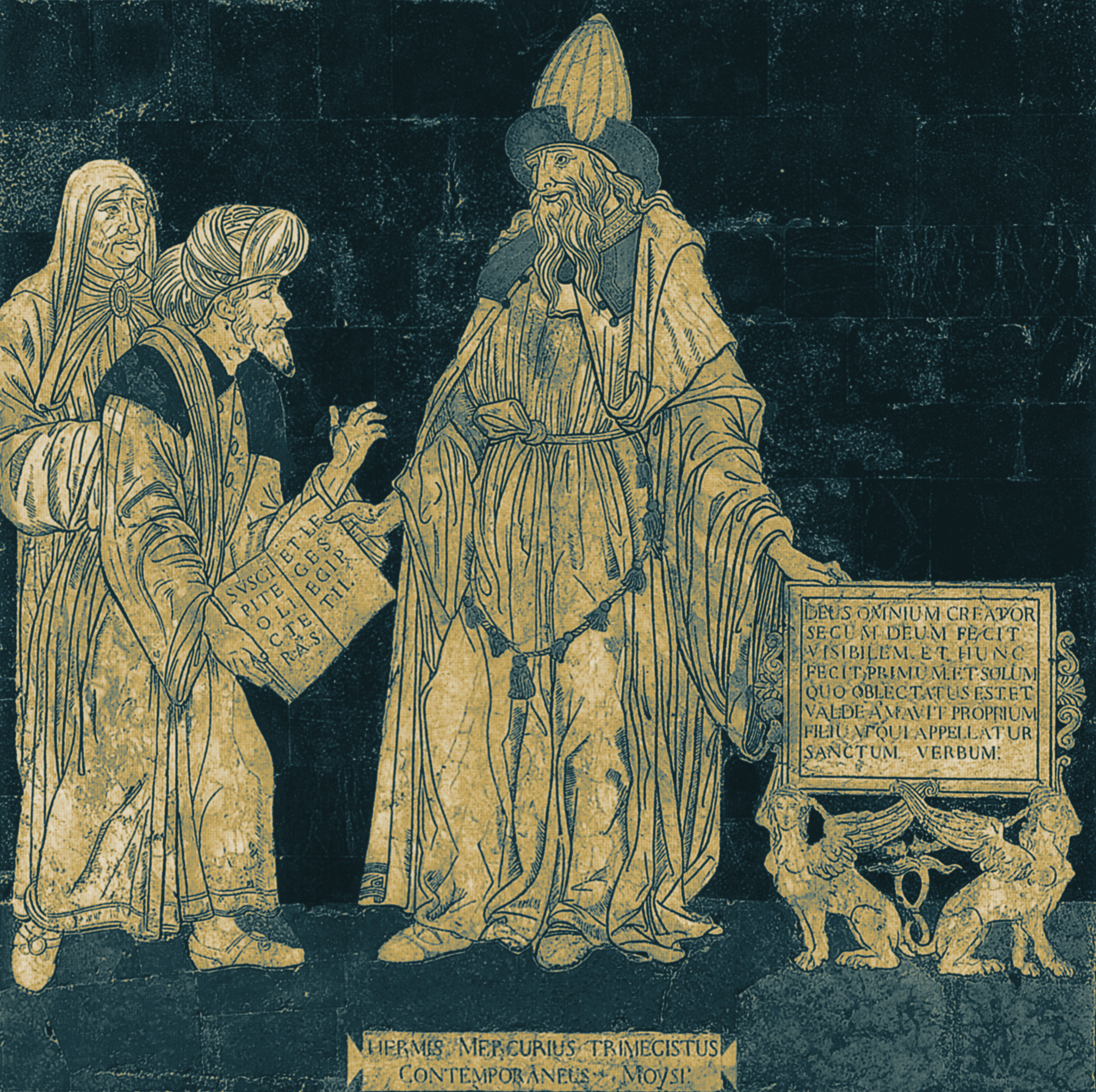
Hermes Trismegistus Sienna Cathedral Mosaic by Giovanni di Stefano
They do come from somewhere real. Behind that phrase sits one of the oldest and most influential threads in Western esoteric thought: the Hermetic tradition. It shaped alchemy, astrology, Renaissance magic, and nearly every mystery school that came after. But the version most of us meet first, the tidy list of seven Hermetic principles, is a lot younger than it looks.
So let's do this properly. We'll meet the man who never existed, open the texts that actually survived from antiquity, give an honest welcome to the little book that made Hermeticism famous, and then walk through each principle in plain language, tracing it back to the ancient words that support it. Some of them hold up beautifully. A couple, it turns out, don't.
Who Was Hermes Trismegistus?
Hermes Trismegistus, "Thrice-Greatest Hermes," was never a single historical person. He was a meeting point. In Hellenistic Egypt, Greek settlers looked at Thoth, the ibis-headed Egyptian god of writing, magic, and wisdom, and saw their own Hermes, messenger between gods and mortals. The two fused into one legendary sage, credited with teaching humanity everything from astrology to alchemy to the secret structure of the soul.
The writings that carry his name are real, though, and they're the heart of this post. There are three main sources:
The Corpus Hermeticum. A collection of Greek dialogues written roughly between 100 and 300 CE, most likely in Alexandria. They read like spiritual conversations: Hermes teaching his son Tat, or his student Asclepius, about God, Mind, the cosmos, and how a soul finds its way home. The first and most famous treatise, the Poimandres, opens with Hermes receiving a vision from divine Mind itself.
The Asclepius. A longer dialogue from the same era whose Greek original was mostly lost. It survived in an early Latin translation, which is how medieval Europe kept a thread of Hermetic thought alive when the Greek texts were unknown in the West.
The Emerald Tablet. A short, cryptic alchemical text whose earliest known versions are in Arabic, compiled around the late 8th or early 9th century. It reached Latin Europe in the 12th century and became the founding scripture of alchemy. This is where as above, so below actually comes from.
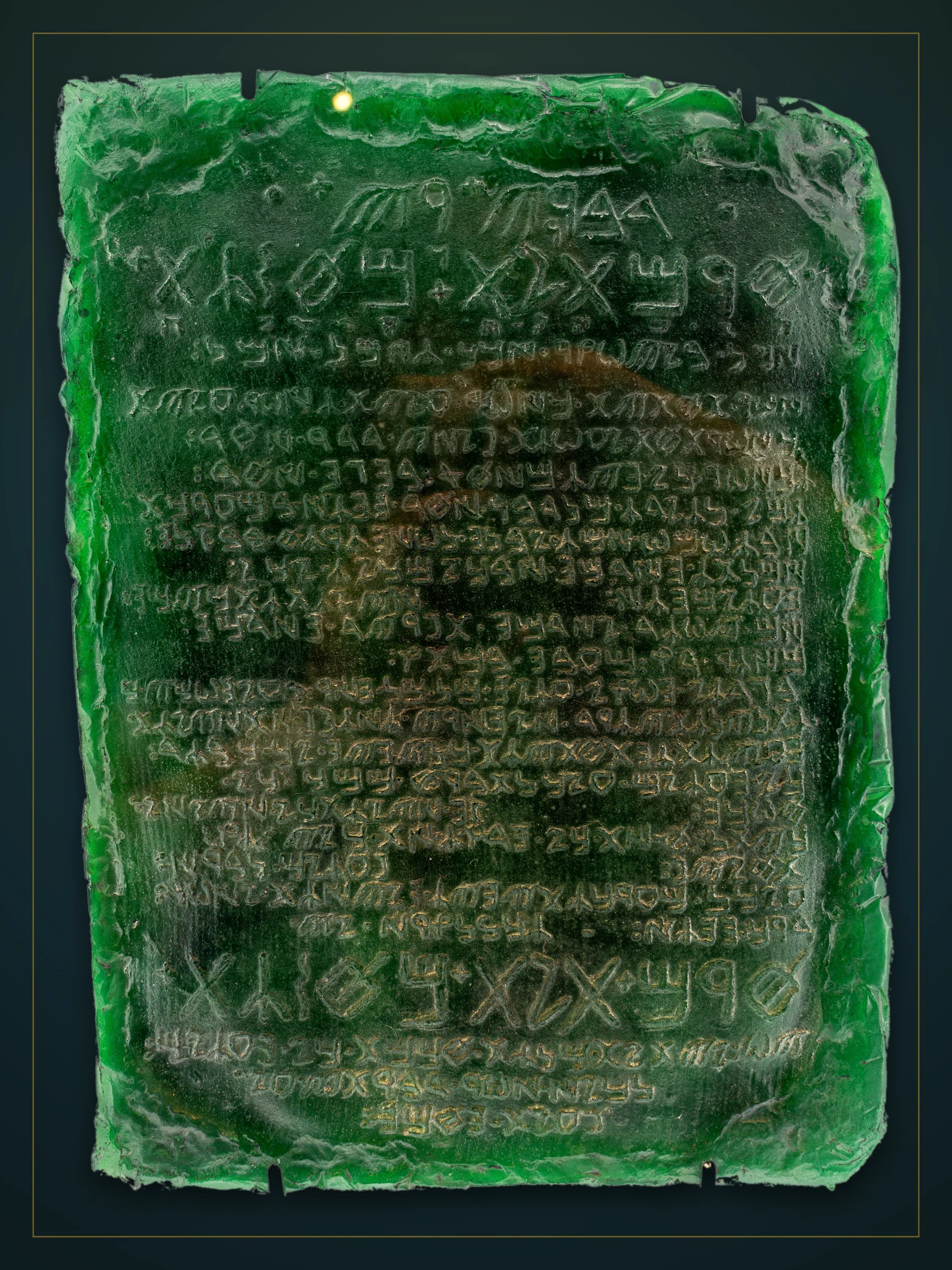
Emerald Tablet, Rosicrucian Alchemy Exhibit
For a long time, people believed these texts were older than Moses. When the Corpus Hermeticum resurfaced in Renaissance Florence, Cosimo de' Medici had Marsilio Ficino stop translating Plato so he could translate Hermes first. Then, in 1614, the scholar Isaac Casaubon studied the Greek and showed it belonged to the early Christian centuries, not the age of the pharaohs.
That doesn't make the Hermetica less meaningful. These are genuinely ancient texts, roughly two thousand years old, born in a city where Egyptian, Greek, and Jewish thought were all braided together. They just aren't primordial. Keep that distinction in mind, because it matters for what comes next.
The Kybalion: A Wonderful Book That Isn't Ancient
In 1908, a small Chicago publisher released a book called The Kybalion: A Study of the Hermetic Philosophy of Ancient Egypt and Greece. The author was listed only as "Three Initiates." It presented seven Hermetic principles as distilled wisdom handed down from Hermes himself, and for over a century it has been the doorway through which most people walk into Hermeticism.
I've read it, I love it, and I recommend it. It's clear, it's practical, and it gives you a working framework you can actually use in daily life. If you've never read it, put it on your list.
But it isn't an ancient text. The "Three Initiates" are widely believed to be William Walker Atkinson, a prolific writer of the New Thought movement, possibly with collaborators. New Thought was an American spiritual current focused on the power of mind over circumstance, the ancestor of much of today's manifestation teaching. You can feel that influence all through the Kybalion. There is no ancient book called the Kybalion, and none of its seven axioms appear in the Corpus Hermeticum, the Asclepius, or the Emerald Tablet as they are written.
So here's how we'll honor both. For each principle, you'll get the Kybalion's version, then the words of the actual ancient Hermetic texts that support it, or don't. All ancient quotes below come from public domain translations: G.R.S. Mead's Thrice-Greatest Hermes (1906) and Isaac Newton's own translation of the Emerald Tablet. Yes, that Isaac Newton. He spent decades on alchemy.
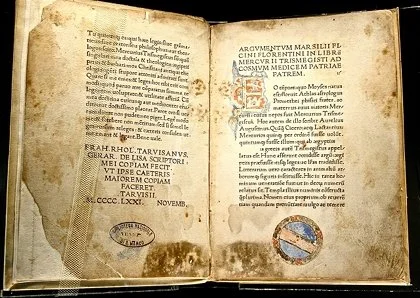
Corpus Hermeticum: first Latin edition
The Seven Principles, Traced to Their Roots
1. Mentalism: Everything Begins in Mind
The Kybalion says: "THE ALL IS MIND; The Universe is Mental."
In plain language: Reality starts as consciousness. Before anything is solid, it is thought. The universe is less like a machine and more like an idea being held in a vast mind.
What the ancient texts say: This one has deep roots. The very first Hermetic treatise, the Poimandres, begins with Hermes meeting a great being who introduces himself as Mind. "I am Man-Shepherd, Mind of all-masterhood," he says, and later, "That Light, He said, am I, thy God, Mind." Another treatise, Mind unto Hermes, describes God "as having all things in Himself as thoughts, the whole Cosmos itself." It also offers one of the most beautiful lines in all of Hermetic writing: "If, then, thou dost not make thyself like unto God, thou canst not know Him."
Verdict: Strong roots. The Kybalion simplified it, but this is genuinely Hermetic.
““If, then, thou dost not make thyself like unto God, thou canst not know Him.” ”
2. Correspondence: As Above, So Below
The Kybalion says: "As above, so below; as below, so above."
In plain language: The patterns of the cosmos repeat at every scale. The movement of the planets, the turning of the seasons, and the shape of your inner life all reflect one another. Understand one level and you gain a key to the others.
What the ancient texts say: Here is the original, in Newton's translation of the Emerald Tablet, spelling and all: "That wch is below is like that wch is above & that wch is above is like yt wch is below to do ye miracles of one only thing." Notice the purpose at the end. The correspondence exists to work wonders, which is why alchemists treasured it. The Asclepius makes the human version of the same point, calling the human being "a mighty wonder," a creature who stands between heaven and earth and shares in both.
Verdict: Strong roots. This is the principle that gave the whole tradition its motto.
3. Vibration: Nothing Rests
The Kybalion says: "Nothing rests; everything moves; everything vibrates."
In plain language: Everything is in motion, from atoms to emotions. What looks solid is simply moving at a different rate than what looks like spirit.
What the ancient texts say: Here's where honesty matters. The ancient Hermetica do teach that the cosmos is always moving and always changing. One treatise asks, "What then in Cosmos is there that hath no motion? Naught is there, son!" Another insists that "nothing in the Cosmos is destroyed" because death is only a change of form. But you won't find vibration, frequency, or rates of motion anywhere in these texts. That language comes from 19th century New Thought and Theosophy, which borrowed freely from the science of their day.
Verdict: Partly rooted. The idea of ceaseless motion and transformation is ancient. The vibration framing is the Kybalion's own.
4. Polarity: Opposites Are One Thing
The Kybalion says: "Everything is Dual; everything has poles; everything has its pair of opposites; like and unlike are the same; opposites are identical in nature, but different in degree."
In plain language: Hot and cold are the same thing, temperature, in different amounts. Love and hate, courage and fear, light and dark: each pair sits on one spectrum, which means you can move along it.
What the ancient texts say: Very little, and sometimes the opposite. The Emerald Tablet does instruct the alchemist to "Seperate thou ye earth from ye fire, ye subtile from the gross," which is a work with opposites. But the Corpus Hermeticum treats them as distinct, not identical. One treatise puts it plainly: "For where is day, nowhere is night; and where is night, day is nowhere." The idea that opposites are secretly the same thing, and that you can transmute one into the other by shifting your mind, is the Kybalion's teaching, shaped heavily by New Thought.
Verdict: Mostly modern. Useful, maybe even true for you, but not ancient.
5. Rhythm: Everything Has Its Tides
The Kybalion says: "Everything flows, out and in; everything has its tides; all things rise and fall; the pendulum-swing manifests in everything."
In plain language: Life moves in cycles. Moons wax and wane, seasons turn, energy rises and falls. Nothing stays at the peak and nothing stays at the bottom.
What the ancient texts say: The ancient sources think in cycles too, though on a cosmic scale rather than a personal one. The Asclepius says that "Order and Time effect renewal of all things which are in Cosmos by means of alternation," and foretells that God "will recall the Cosmos to its ancient form," a great rebirth of the world. Another treatise describes the order of the heavens being preserved through the cyclic return of the stars to their original positions. The pendulum, though, with its equal swing to each side, is a Kybalion image.
Verdict: Partly rooted. Cycles and renewal are ancient. The pendulum law is modern.
6. Cause and Effect: Nothing Happens by Chance
The Kybalion says: "Every Cause has its Effect; every Effect has its Cause; everything happens according to Law; Chance is but a name for Law not recognized."
In plain language: Nothing is random. Everything has a reason, even when we can't see it, and our actions set causes in motion whether we intend them or not.
What the ancient texts say: This has solid roots, though the ancient version sounds more like destiny than personal responsibility. The Asclepius describes three great powers governing the world: Fate, Necessity, and Order. "First, then, is Fate, which, as it were, by casting in the seed, supplies the embryo of all that are to be." Another treatise is even more direct: "All works, my son, are Fate's." The Hermetic path, though, is about the soul rising above Fate through knowledge of God, which is a far cry from simply accepting it.
Verdict: Strong roots, with a different emphasis. Ancient Hermetics spoke of Fate. The Kybalion speaks of Law.
7. Gender: The Masculine and Feminine in All Things
The Kybalion says: "Gender is in everything; everything has its Masculine and Feminine Principles; Gender manifests on all planes."
In plain language: The Kybalion means creative forces, not people. Every act of creation needs a projecting, initiating energy and a receiving, gestating one.
What the ancient texts say: This is where the ancient sources surprised me, because they're more radical than the Kybalion. In the Poimandres, divine Mind is "male and female both, as Light and Life subsisting." The first humans are described as "male-female," whole beings who were only later divided. And in the Asclepius, God is "all-complete in the fertility of either sex, ever with child of His own Will." The ancient Hermetic divine isn't a father with a separate mother. It's one being who holds both, eternally pregnant with creation.
Verdict: Strong roots, and richer than the Kybalion's version. Where the Kybalion separates, the Hermetica unites.
At a Glance
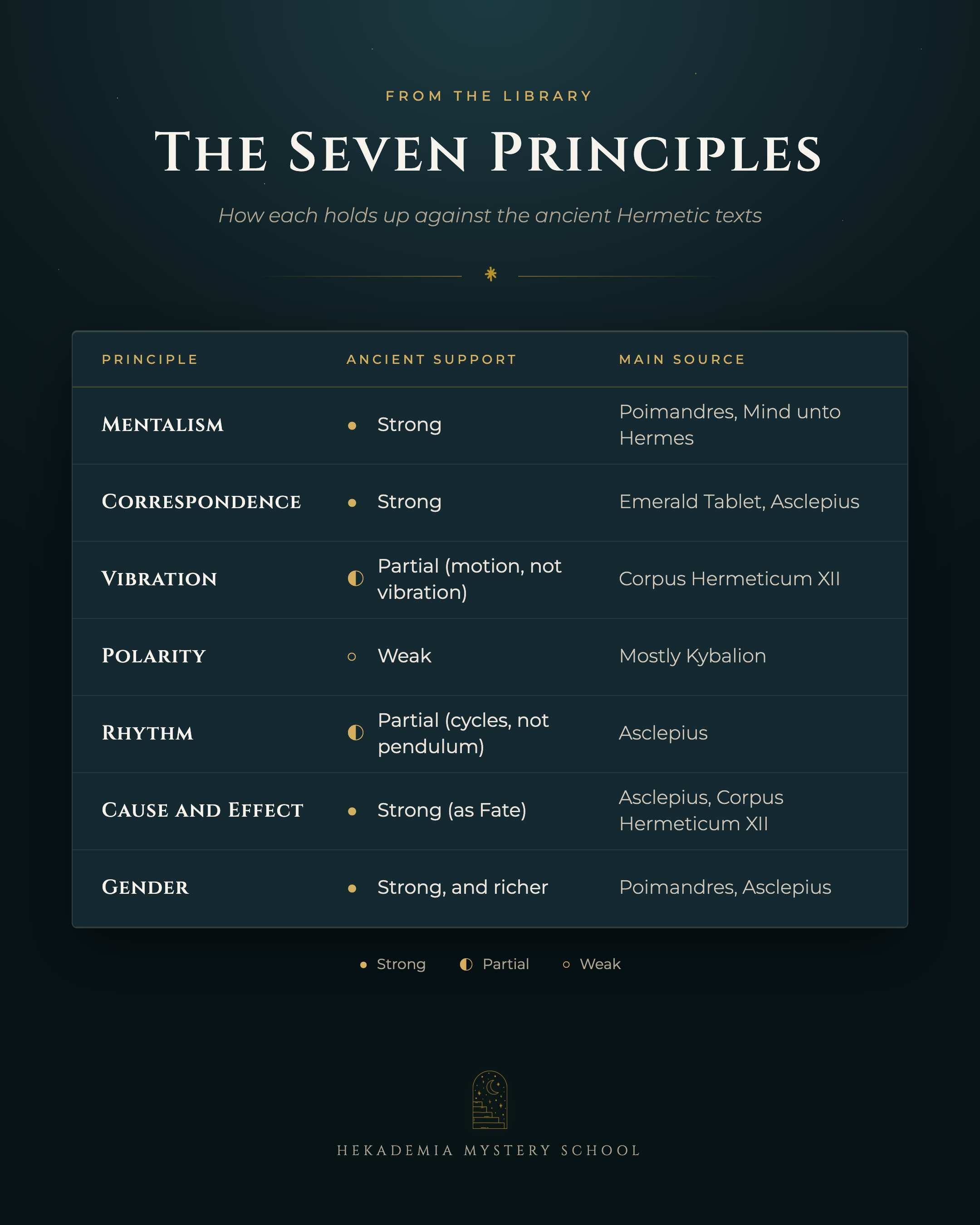
Where You Already Live These Principles
If any of this feels familiar, it's because you've probably been practicing Hermeticism without calling it that.
Every time you look at a birth chart, you're working with Correspondence. Astrology rests entirely on the idea that the patterns of the sky mirror the patterns of a life. The same is true of moon work. When you set intentions at the new moon and release at the full, you're treating the moon's cycle as a reflection of your own.
The Wheel of the Year is Rhythm made visible. Eight turning points, light growing and fading, the earth breathing out in summer and in during winter. The ancient Hermetic idea of renewal through alternation is the same truth every Samhain and every Beltane teaches.
And the dark feminine lives right inside Gender. The Hermetic divine is not only light and projection. It is also the womb, the receptive dark where things gestate before they're born. A God described as "ever with child of His own Will" holds the dark feminine at the very center of creation, not at its edges.
This is why Hermeticism keeps showing up wherever mystery schools do. It isn't one more topic among many. It's the logic underneath the rest.
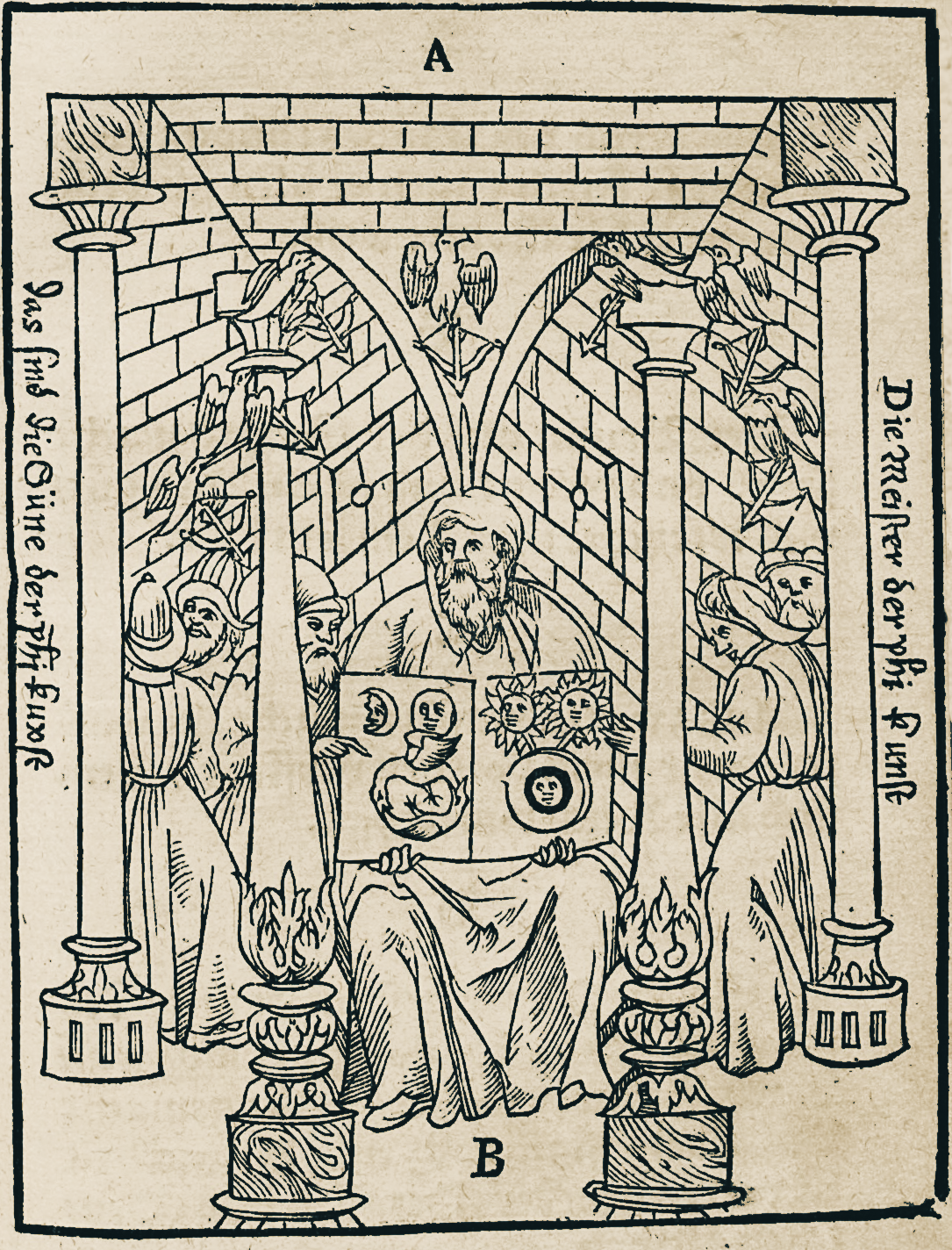
“Pandora—that is the noblest of God's gifts.” Depicts Hermes Trismegistus below nine eagles in a pyramid holding the Emerald Tablet inscribed with pictoral hieroglyphs.
Nature as Scripture
This is the part of Hermeticism I don't just study. I live by it.
When I find myself sitting with the biggest questions, the ones about God, eternity, and what happens when we die, I don't go looking in books first. I go outside. Because if as above, so below is true, then the answers to the largest mysteries aren't hidden somewhere far away. They're written into everything around us, at every scale, all the time. The same pattern that moves the stars moves the sap in a tree. Nature is the one text that has never been mistranslated.
I've formed many of my deepest beliefs this way. Take death. Walk into any old forest and you'll find fallen trees slowly becoming soil, feeding the seedlings that grow out of them. Nothing is lost. It only changes form. When I later read the Hermetic line that "nothing in the Cosmos is destroyed," it didn't feel like new information. It felt like confirmation of something the forest had already taught me.
Or eternity. Every winter looks like an ending, and every spring answers it. A seed holds the whole tree inside it before it ever breaks ground. These aren't metaphors I'm laying over nature. In the Hermetic view, they're the same truth showing up on a different level.
That's what the ancient writers meant when they described God as "having all things in Himself as thoughts, the whole Cosmos itself." If the cosmos is the mind of the divine made visible, then a river, a mushroom, a thunderstorm, and the turning of the year are all ways of reading that mind.
So here is the practice, and it's a simple one. The next time a question sits heavy in you, one you can't think your way through, take it outside. Don't look for a sign. Just watch. Notice how the world around you handles the very thing you're wrestling with: endings, beginnings, waiting, letting go. Ask what is true here, at this level, and trust that it's true above as well.
The Kybalion is a beautiful door, and the Hermetica is the house behind it. But the oldest teacher of all has always been right outside.
“The Kybalion is a beautiful door. The Hermetica is the house behind it.”
If this is the kind of study that lights you up, there's much more waiting in The Library. Hermeticism is only one thread. Kabbalah, the mysteries of ancient Egypt, the true history of secret societies, and a teaching for every new moon, full moon, and zodiac season are all on the way. Join the Initiates to receive each one as it's published, and be the first to know when Hekademia opens its doors at the Winter Solstice.
Sources
The Kybalion, Ch. II: The Seven Hermetic Principles (Three Initiates)
Corpus Hermeticum I, Poemandres (Mead, 1906)
Corpus Hermeticum VIII (Mead)
Asclepius (Perfect Sermon), Mead: VI, XX to XXI, XXVI, XXX, XXXIX to XL