Say the word alchemy and most people picture a bearded man in a smoky workshop trying to turn lead into gold. That man was real. There were thousands of him, actually, including Isaac Newton, who wrote over a million words on the subject. But from almost the very beginning, some alchemists were saying something stranger: that the furnace was also inside them, and the metal being refined was the soul.
That inner reading is what this post is about. The old alchemists mapped the Great Work in colors. First black, then white, then (for a few centuries) yellow, and finally red. Nigredo, albedo, citrinitas, rubedo. If you have ever been through something that broke you down and slowly put you back together as someone new, you already know these colors. You just may not have had names for them.
What Alchemy Actually Was
Alchemy was born in the workshops of Greco-Roman Egypt in the first few centuries CE. Its earliest surviving texts come out of the practical crafts: dyeing cloth purple, tinting metals, making alloys that looked like gold and silver. The oldest of these, a collection called Physika kai Mystika ("Natural and Secret Matters"), was written under the name of Democritus, though not by the famous philosopher. It mixes workshop recipes with hints of something more mysterious.
The word itself took a long road to reach us. English got it from medieval Latin, which got it from the Arabic al-kimiya, which came from the Greek chemeia. Some scholars connect that Greek word to Kemet, the ancient Egyptians' name for their own land. Kemet means "the black land," after the dark, fertile silt the Nile left behind every year. Nobody can prove the connection, but it's a lovely thought for a tradition that begins its work in blackness.
From Egypt, alchemy passed into the Islamic world, where scholars writing in Arabic refined it for centuries, and from there into Latin Europe in the 1100s. For most of that history, alchemy was hands-on chemistry. These were people heating real substances in real vessels, and many of their discoveries became the foundation of modern chemistry. So when we talk about alchemy as inner transformation, we are not saying the lab work was "just a metaphor." We are saying that for some alchemists, the two were never separate.
Zosimos and the Priest in the Bowl
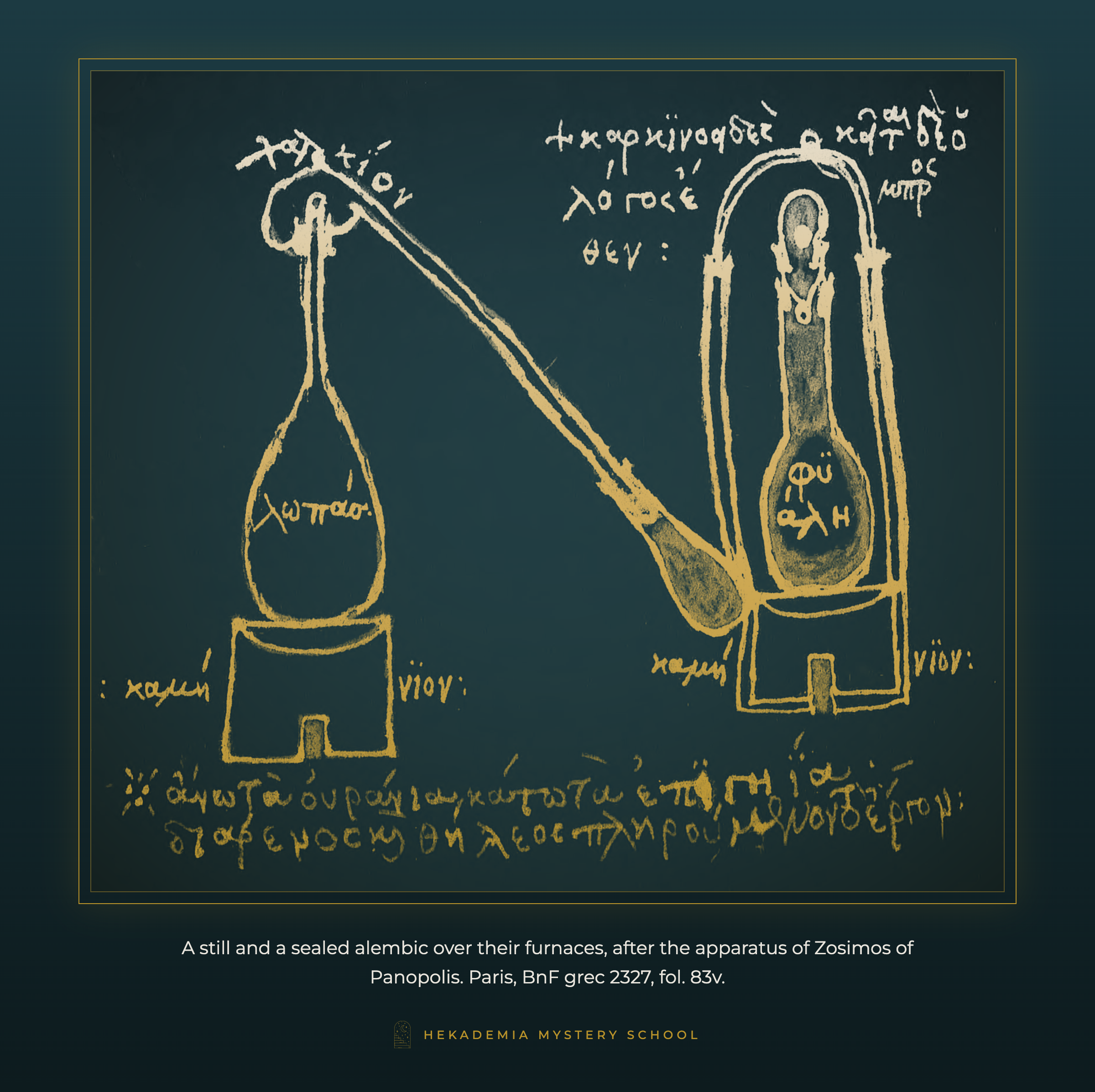
The first alchemist we know as a real person, with a name, a hometown and a body of writing, is Zosimos of Panopolis. He lived around 300 CE in Panopolis, a city in Upper Egypt now called Akhmim, where the old Egyptian temples were still active alongside Hermetic and Gnostic circles. Much of what he wrote is addressed to a woman named Theosebeia, who seems to have been both his student and a teacher of alchemy in her own right. Zosimos also credits an earlier woman, Maria the Jewess, with inventing key pieces of lab equipment. Her name survives in your kitchen: the bain-marie, or "Mary's bath."
Zosimos is also the earliest alchemist to describe the Work as something that happens inside a person. In a text known as his Visions, he falls asleep and dreams of an altar shaped like a bowl, reached by fifteen steps. A priest stands at the top and introduces himself. In my own rendering of the Greek: "I am Ion, priest of the inner sanctuaries, and I submit myself to an unbearable torment."
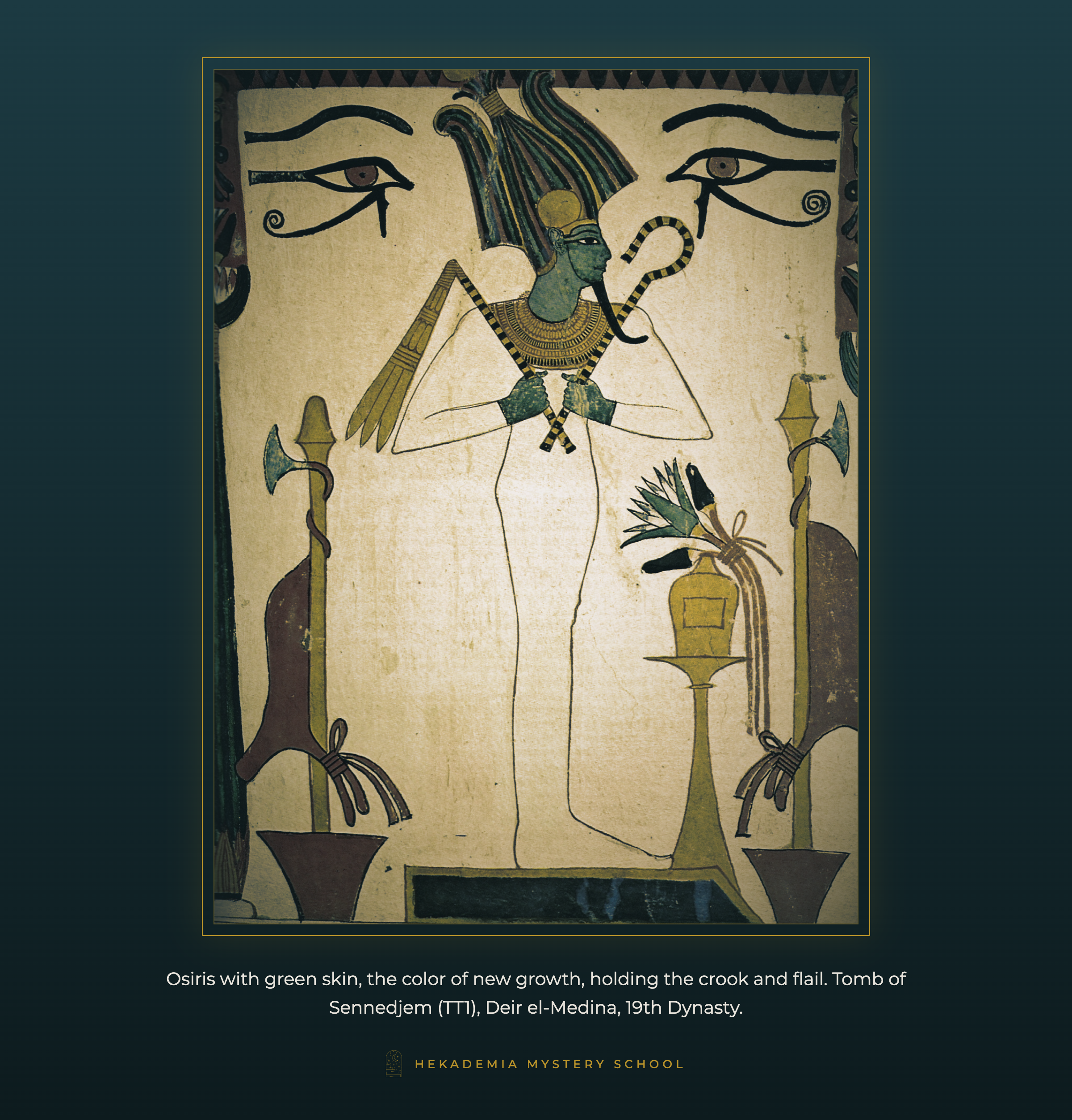
What follows is not gentle. Ion is cut apart "according to the rule of harmony," burned, and transformed into the opposite of what he was. Zosimos wakes up and asks himself a question that tells us exactly what he's dreaming about: "Is this not the composition of the waters?" The waters were his chemical process. The dismembered priest was the same process, told as the story of a human being. When he falls back asleep the dream continues, and the people boiling in the bowl become spirits. Some scholars think this imagery of altars and dismemberment drew on the rites of Osiris still practiced in his region. (More on Osiris later this month.)
In another letter, Zosimos gives Theosebeia advice that could come from a meditation teacher today. He tells her to stop running around searching for the divine, to sit quietly at home, settle her body and her passions, and let the divine come to her, since it is everywhere anyway. Seventeen hundred years later, that is still the instruction.
The Colors of the Work
The Greek-speaking alchemists divided the Work into four stages, each named for the color the material turned in the vessel. Latin alchemists later translated these into the names most people know today. Then, around the fifteenth and sixteenth centuries, the yellow stage quietly dropped out, and most writers began describing the Work in three. That's why you'll see both versions, and why this post brings back the stage that got lost.
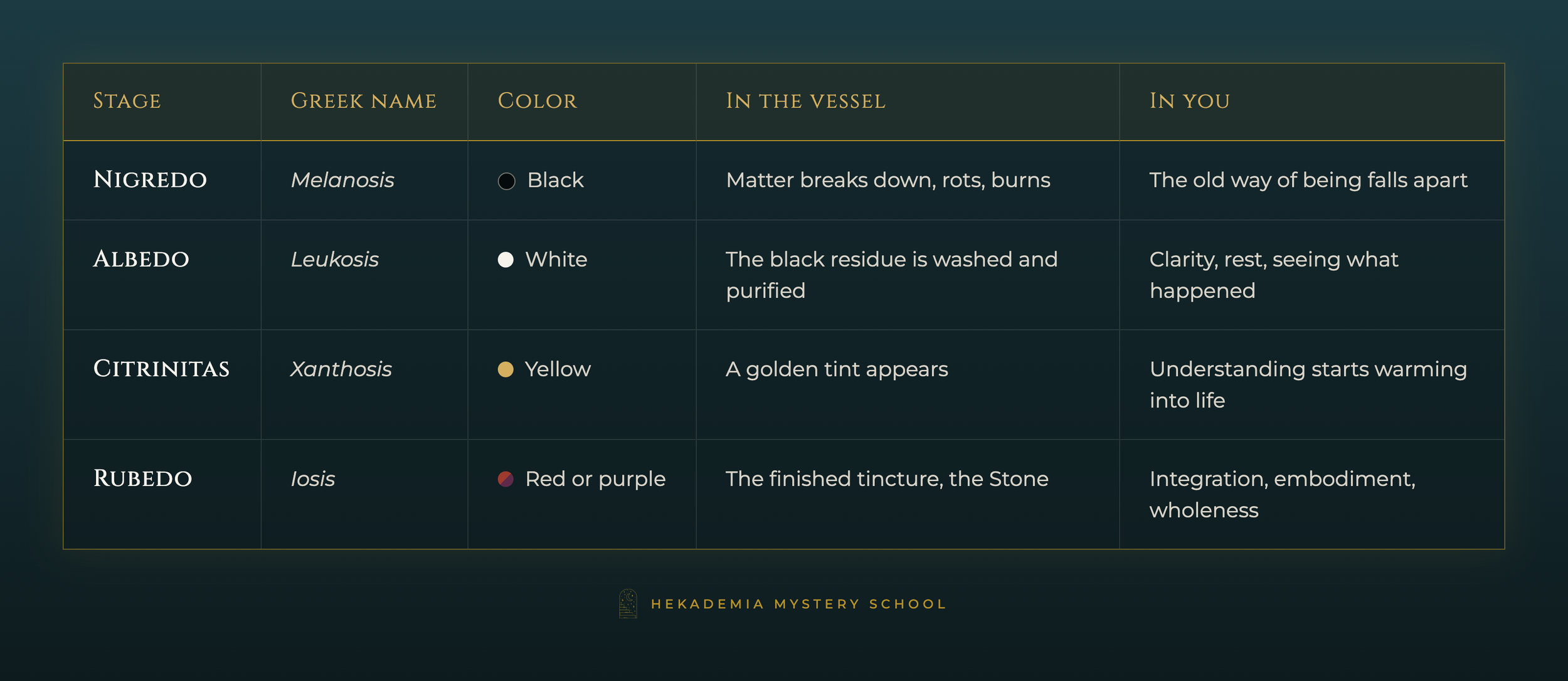
The colors weren't invented as symbols. They were things alchemists actually watched happen: the black of burned or rotting matter, the white of a purified salt or a silvered metal, the gold and red of their most prized tinctures. The inner meaning grew out of the outer observation. As above, so below. As in the vessel, so in the soul.
Nigredo: The Blackening
Nigredo comes first, and it's the one nobody wants. In the lab it meant putrefaction: the material was burned, dissolved or left to rot until its original form was gone and only a black mass remained. Alchemical art pictures it as a raven, a skull, a corpse in a coffin, or a sun gone black.
Here's the part that surprises people. In the vessel, black was good news. It meant the work had actually begun. An alchemist who never saw the blackening had nothing to purify, because nothing had been broken down yet.
“In the vessel, black was good news. It meant the work had begun.”
In a human life, nigredo is the season when the thing you built yourself around stops working. A relationship ends. A faith cracks. A death, a move, a loss, a ceremony that shows you something you can't unsee. Old certainties rot, and for a while there's nothing to replace them. It feels like failure. The alchemists would say it's the first sign of gold.
It's no accident that nigredo pairs so naturally with this time of year. The days are shortening, the leaves are composting into the ground, and the whole Northern Hemisphere is in its own blackening. Nature doesn't rush the rot. Neither should you.
Albedo: The Whitening
After the black comes the white. In the lab, the dark residue was washed over and over, sometimes for weeks, until it came clean. Alchemists called this ablutio, the washing, and this is where Zosimos's "waters" do their work. Albedo belongs to the Moon and to silver. Its images are the swan, the white rose, the dove, the white queen.
“Albedo is understanding, not yet living. The Work asks for more heat.”
In you, albedo is the moment the grief clears enough that you can see. You can finally name what happened and what it meant. Tears belong to this stage. So do sleep, solitude, journaling, and long talks that leave you lighter. It often feels like peace, and it is.
But it's lunar peace: cool, reflective, quiet. The Moon shines by borrowed light. Albedo is understanding, not yet living. Plenty of people stop here, holding a clear and beautiful insight that never changes how they get out of bed in the morning. The Work asks for more heat.
Citrinitas: The Lost Stage
Citrinitas, the yellowing, is the dawn between the Moon and the Sun. The Greek alchemists treated it as essential. By the end of the Middle Ages most writers had folded it into the red stage and stopped mentioning it, and it's been largely forgotten ever since.
I think it's worth keeping. Citrinitas is the awkward in-between where insight starts becoming action. You understand the lesson, and now you start testing it. You set the new boundary and feel how uncomfortable it is. You show up differently once, then again. It's yellow because it isn't fully gold yet. It's the first warm light on the horizon, and a reminder that transformation isn't complete the moment you understand it. It's complete when you live it.
“Transformation isn’t complete the moment you understand it. It’s complete when you live it.”
Rubedo: The Reddening
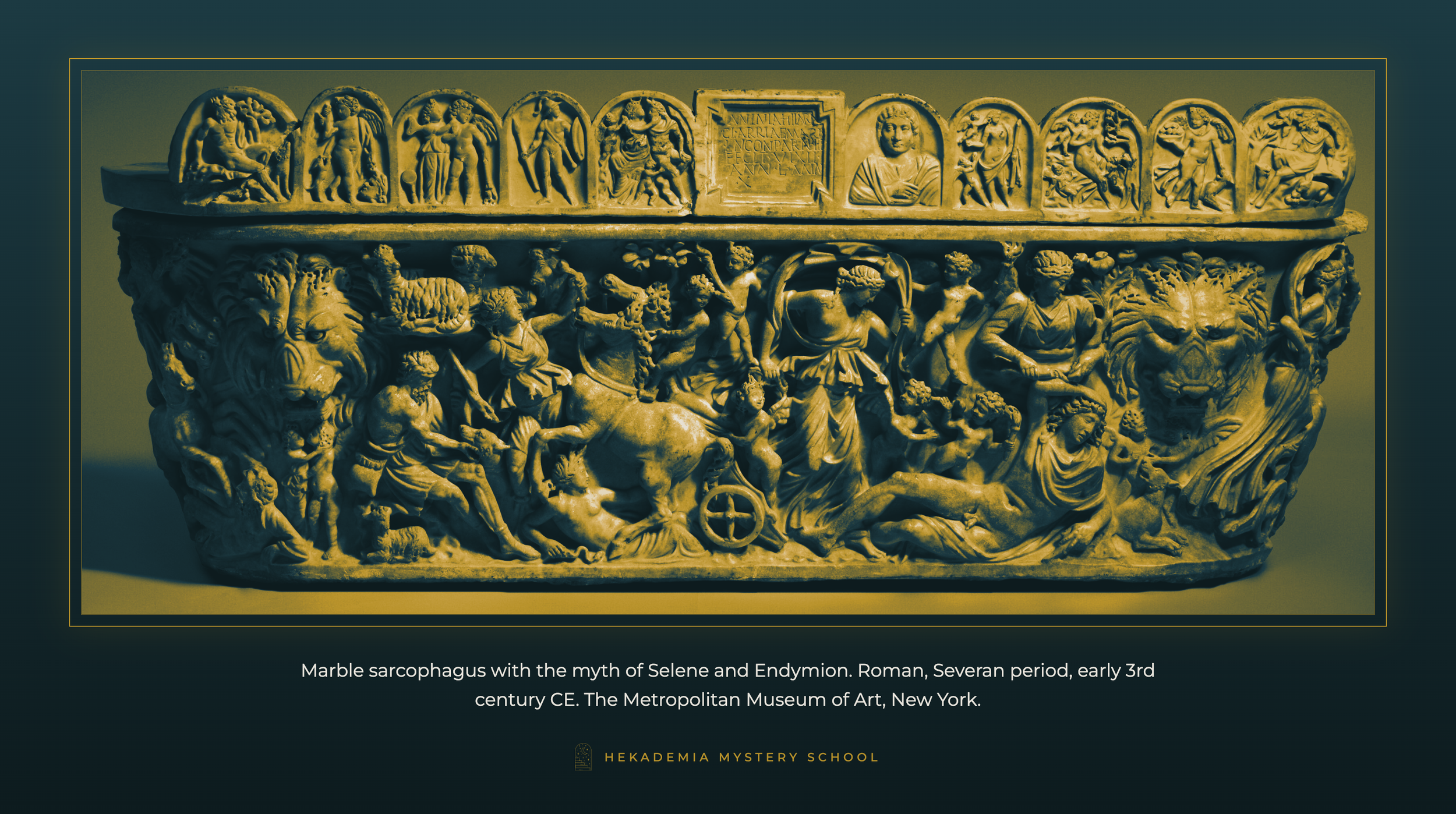
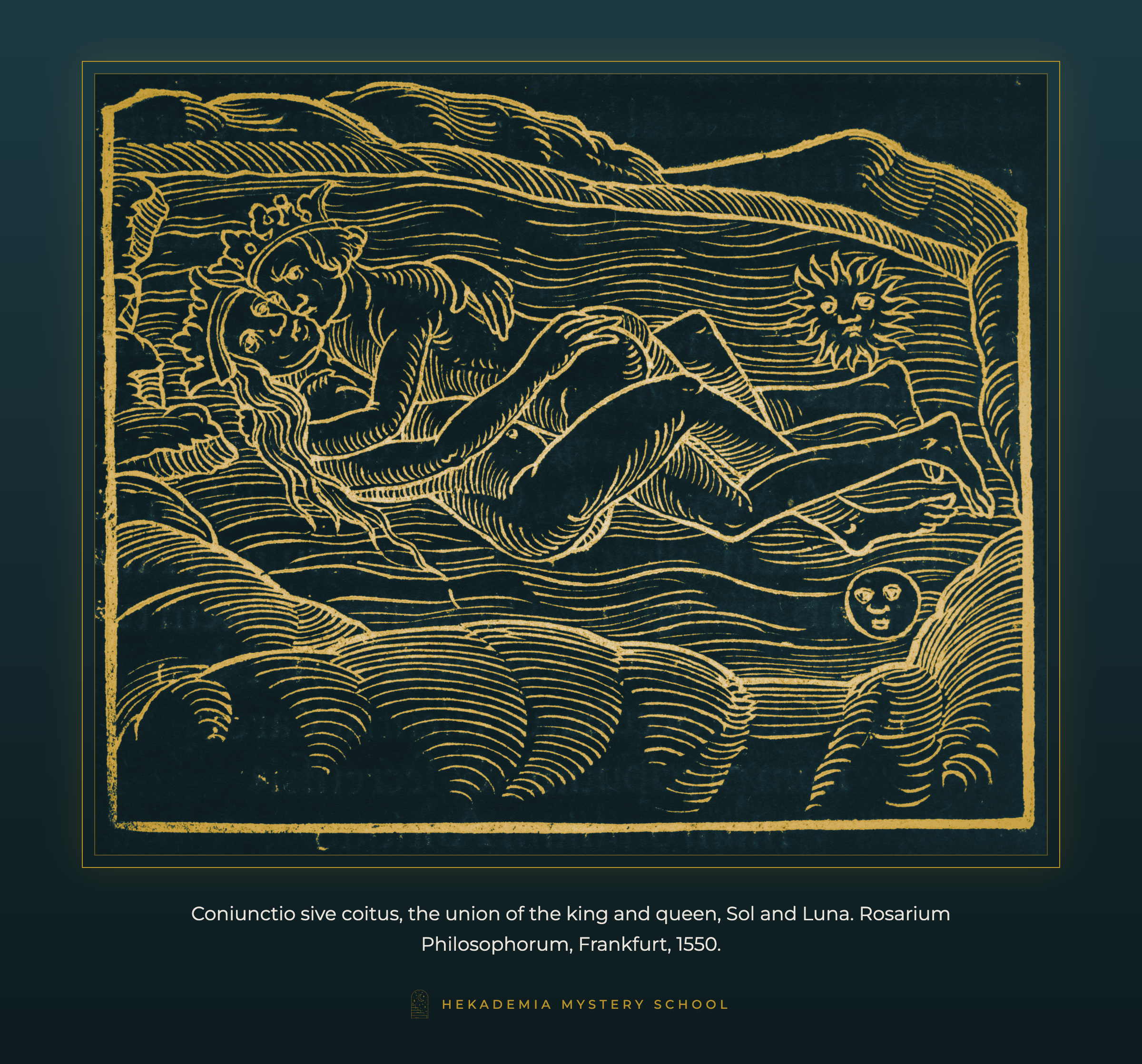
Rubedo is the completion of the Work: the red stone, the elixir, the gold. In alchemical art it's often shown as a marriage, the red king and the white queen joined in one body, the Sun and Moon united. The opposites that were pulled apart in the earlier stages come back together, transformed.
In a person, rubedo is integration. What you learned in the dark and understood in the white is now in your blood. It's warm, embodied, alive. It isn't perfection. You still carry the black and the white inside you, but they no longer fight. They've become part of who you are.
The legends said the Philosopher's Stone could transform other metals just by touching them. I love that detail. A person who has truly been through the fire changes the people around them, not by preaching, but simply by being who they've become.
A Spiral, Not a Ladder
It would be easy to read the four colors as a ladder: climb from black to red, collect your gold, done. The alchemists didn't see it that way, and I don't either.
“You will go black again. But you won’t be in the same place on the spiral.”
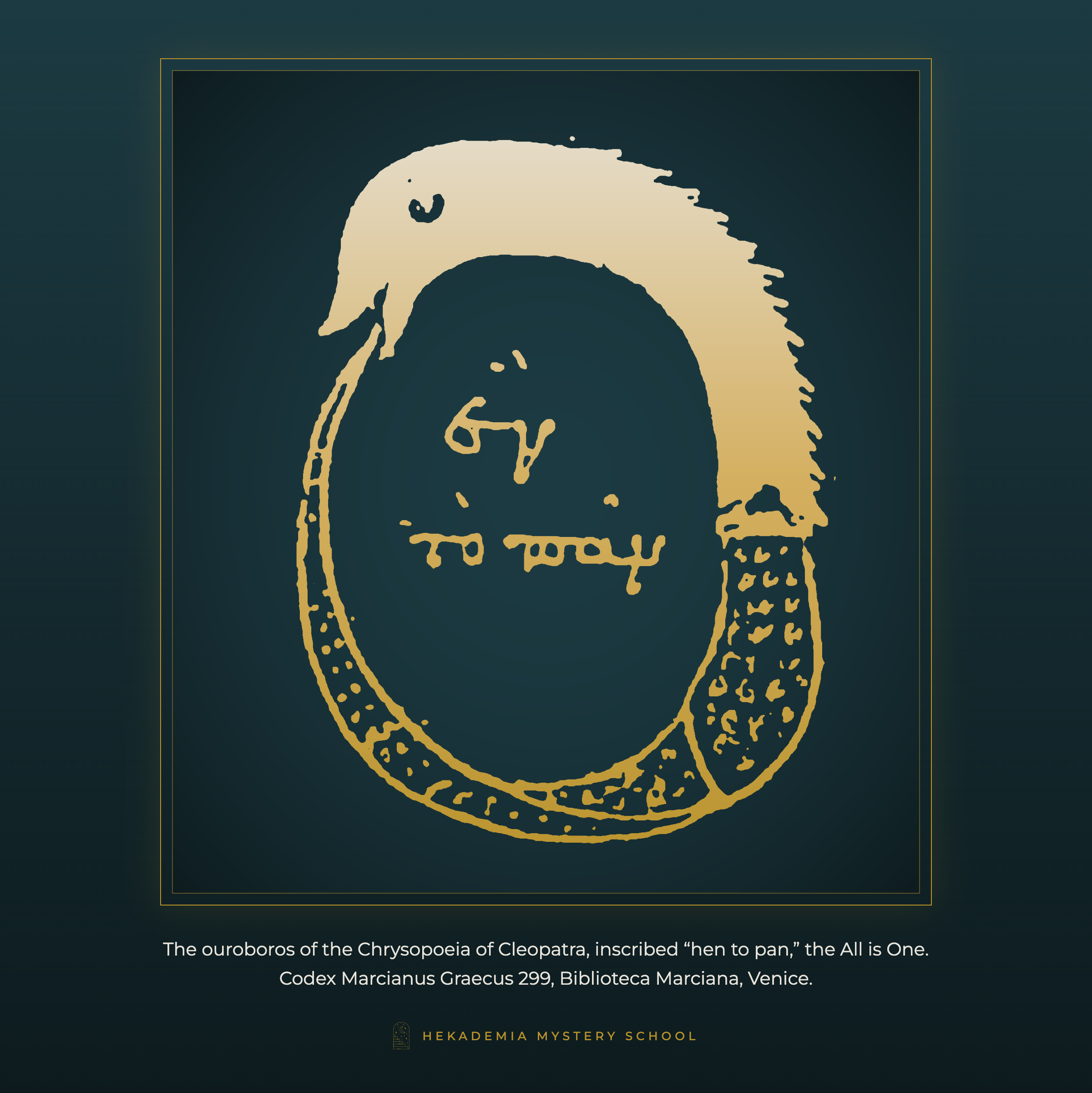
One of the oldest alchemical images we have comes from a Greek manuscript page known as the Chrysopoeia of Cleopatra ("Cleopatra's Gold-Making"). It shows the ouroboros, a serpent swallowing its own tail, with the words hen to pan written inside its circle: "One is the All." The ending feeds the beginning. In the lab, alchemists repeated the same operations again and again, dissolving and recondensing, distilling and redistilling, each pass refining the material a little further.
The Emerald Tablet, a short Hermetic text that circulated in Arabic by around the eighth or ninth century and became the touchstone of European alchemy, describes the same motion. In Isaac Newton's translation: "It ascends from the earth to the heaven and again it descends to the earth, and receives the force of things superior and inferior."
That's how transformation actually works. You will go black again. Something else will fall apart someday. But you won't be in the same place on the spiral. You'll recognize the raven when it lands. You'll know the washing comes next. And you'll trust, from experience, that there is gold on the other side.
What Isn't Ancient
Alchemy has gathered a lot of lore over the centuries, and plenty of it gets labeled "ancient" online. Here's where some of the most popular pieces actually come from.
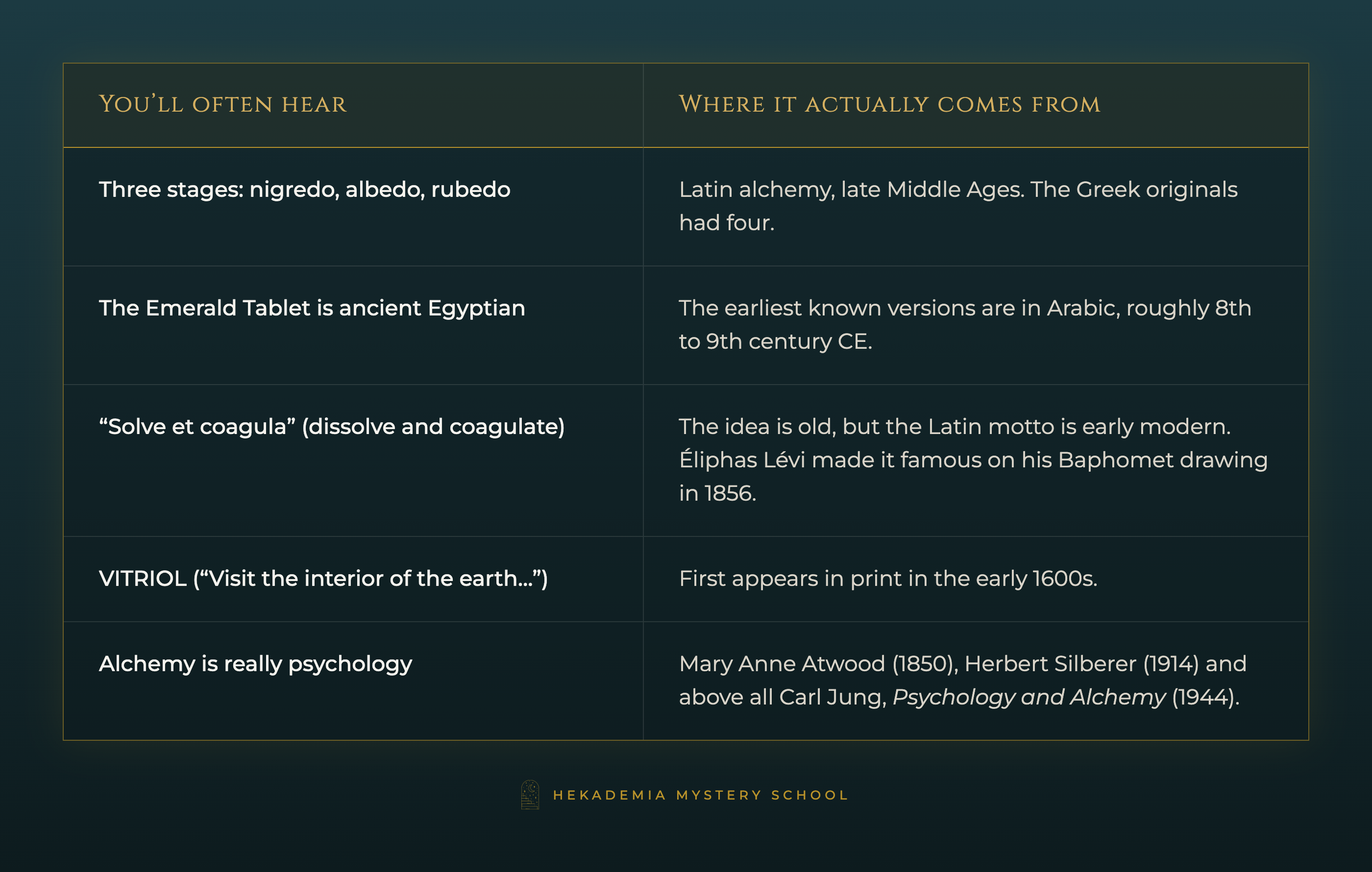
That last one deserves some nuance. Jung didn't invent inner alchemy. Zosimos was already there around 300 CE. But Jung built it into a full psychological map, and much of what you'll read about alchemy online today is Jung's reading rather than the alchemists' own. Historians like Lawrence Principe have pushed back, reminding us that most alchemists were doing real chemistry and would have been puzzled by the idea that it was all symbolic. Both things are true. The lab was real, and so was the inner fire some alchemists felt burning alongside it.
If you want to keep going, I recommend Jung's Psychology and Alchemy (dense, but extraordinary) alongside Principe's The Secrets of Alchemy for the historian's view. And if you've read The Kybalion, its chapter on mental transmutation is a beautiful modern take on these ideas. Just know it was published in 1908, not handed down from ancient Egypt.
Practice: Find Your Color
You don't need a laboratory to work with these stages. You need a notebook, some honesty, and a little patience. The alchemists kept careful records of every operation, and this practice borrows that habit.
Name your vessel. What situation, relationship or season of life is "cooking" you right now? Write it at the top of a fresh page.
Find your color. Read back through the four stages and ask which one feels most true. Black: things are falling apart and you don't know what comes next. White: the dust is settling and you're starting to understand. Yellow: you're trying to live what you've learned and it feels awkward. Red: it's simply part of you now.
Work with the stage you're in, not the one you wish you were in. In nigredo, rest, grieve and let things compost. Don't force answers. In albedo, wash: cry, bathe, write, talk it through. In citrinitas, take one small action that matches what you've learned. In rubedo, share it. Teach it, make art from it, let it change how you treat people.
Date your entries by the Moon. Note the moon phase each time you come back to this page. Over a year you'll start to see your own spiral: the same colors returning, but never in quite the same place.
If you're in the black right now, this is the season for it. Let the dark half of the year hold you. The washing is coming.
Join the Initiates
Hekademia Mystery School opens its doors at the Winter Solstice 2026. If you'd like a few secrets worth keeping delivered to your inbox before then, join the Initiates.